6 Best Energy Efficient Space Heaters (October 2026)
The best energy efficient space heaters include the DREO 1500W Thermostat Heater for everyday room heating, the DREO 25 Inch Space Heater for quiet home offices, and the Lasko Digital Tower Heater for short heating sessions.
On this page (8 sections)
- How we chose energy efficient space heaters
- Best energy efficient space heater picks
- What actually lowers a space heater's electricity use?
- Is an oil filled radiator more efficient than a ceramic heater?
- How do you match the heater to your room?
- How should you set up and care for a space heater?
- Which mistakes waste heat or lead to the wrong purchase?
- Which best energy efficient space heater fits your routine?
The best energy efficient space heater for most rooms is the DREO 1500W Thermostat Heater, because its ECO control adjusts heat as the room temperature changes. For longer, quiet sessions with lower manual power options, choose the DREO Oil Filled Radiator.
The biggest savings come from heating the space you occupy and avoiding excess warmth. A heater with useful controls can support that plan, but your room and routine determine how much electricity it needs.
Start with how much electricity space heaters use and how to estimate space heater running costs. Our best space heaters for home guide compares the wider range of heating styles.
Our picks at a glance
-
1

-
2

-
3
- 4
 Best for long quiet sessionsCheck it
- 5
 Best for shared seating areasCheck it
- 6
 Check it
Amazon Basics Remote Oil Heater
Best for fan-sensitive readers
How we chose energy efficient space heaters
Useful heat control matters more than an energy-saving label. NeatUpgrade compared available power settings, thermostat controls, timers and heating styles to find options for different room routines.
Every model here reaches 1500W at maximum output. None offers a special way to turn the same electricity into far more room heat than another resistance heater.
The ranking favors controls that make it easier to avoid unnecessary heating. A lower-ranked radiator can still be the better choice if you dislike fan airflow or need a lower fixed power setting.
Coverage claims help narrow the choices, but they aren't promises about your room. A drafty corner room can lose heat much faster than an interior room of the same size.
| Product | Best for | Power | Heating style | Coverage | Our score |
|---|---|---|---|---|---|
| DREO 1500W Thermostat Heater | everyday room heating | 1000W or 1500W in ECO mode | PTC ceramic, forced air and convection | DREO specifies 270 sq ft | 8.9 |
| DREO 25 Inch Space Heater | quiet home offices | 1500W maximum | PTC ceramic, forced air and convection | DREO specifies 100–270 sq ft | 8.6 |
| Lasko Digital Tower Heater | short heating sessions | 1500W maximum | Ceramic forced air | 8.5 | |
| DREO Oil Filled Radiator | long quiet sessions | 600W, 900W or 1500W | Radiant oil filled radiator | DREO specifies 250 sq ft | 8.1 |
| Pelonis 30 Inch Tower Heater | shared seating areas | 1500W maximum | Ceramic convection | Pelonis claims up to 280 sq ft | 7.7 |
| Amazon Basics Remote Oil Heater | fan-sensitive readers | 600W, 900W or 1500W | Radiant oil filled radiator | 7.1 |
Best energy efficient space heater picks
Choose the DREO thermostat tower for everyday automatic control, or a radiator for longer sessions without fan-driven warmth. The other towers suit buyers who value fine adjustments, simple shutoff controls or sweeping airflow.
1. DREO 1500W Thermostat Heater: best energy efficient space heater overall
DREO 1500W Thermostat Heater
- Sensor-based ECO control
- 70° oscillation
- 12-hour timer
Choose this compact tower for automatic heat adjustment during everyday room use. Its oscillation helps share warmth across a seating or work area.
Pros
- Automatic power adjustment in ECO mode
- Compact tower shape
- Remote control
Cons
- Lower ECO power is still 1000W
- Fan airflow may not suit everyone
This DREO is the strongest starting point for someone who wants to warm an occupied room without changing settings throughout the day. Its sensor-based ECO mode switches between 1000W and 1500W as conditions change.
That makes it a better fit for automatic room heating than for someone seeking a very low fixed draw. If a lightly chilled study needs only gentle background warmth, one of the radiators offers lower manual options.
The tower stands about 15.8 inches tall, making it easier to place below a window line or beside furniture than the taller towers here. Keep the full intake and outlet clear rather than fitting it into a tight gap.
DREO claims noise around 34 dB, and the heater includes a remote and a 12-hour timer. Those features suit desk work or an evening sitting nearby, with the timer acting as a backup shutoff.
Skip it if moving air bothers you or you specifically want radiator-style warmth. For more choices in this format, see our ceramic tower heater picks.
2. DREO 25 Inch Space Heater
DREO 25 Inch Space Heater
- Temperature adjusts in 1°F steps
- ECO and fan modes
- Child lock
Fine temperature adjustments suit people who work in one room for long stretches. DREO claims operating noise as low as 25 dB.
Pros
- Fine thermostat adjustments
- Three heat levels plus ECO
- Remote control
Cons
- Fan sound varies with operation
- Taller than the top pick
The taller DREO suits a home office where small temperature changes affect comfort. Its thermostat adjusts in 1°F steps from 41°F to 95°F, so you can make a small correction instead of jumping between broad heat settings.
ECO mode uses a dedicated temperature sensor, while three manual heat levels provide another way to control output. A fan-only mode is also available, though it doesn't provide cooling like an air conditioner.
DREO claims noise as low as 25 dB. That makes this a sensible option to consider for concentration, but the minimum figure doesn't establish how every mode will sound beside your desk.
A child lock helps prevent unwanted control changes; it doesn't keep children away from the heater. Place the tower outside walkways and leave enough room for its oscillating airflow.
Choose it over the shorter DREO when fine adjustments and the lower claimed noise figure matter more than compact height. Skip it if you want no fan sound, and use our space heater wattage guide to understand power settings.
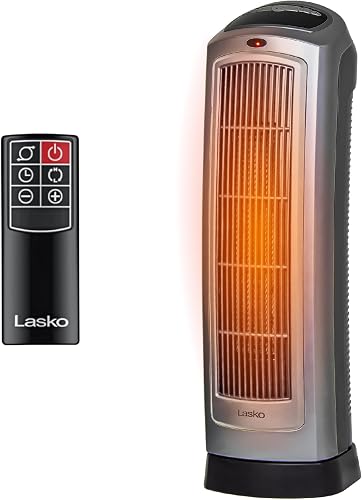
3. Lasko Digital Tower Heater
Lasko Digital Tower Heater
- Low and high heat settings
- Adjustable thermostat
- 1–8 hour shutoff timer
Low and high settings keep daily operation simple. Its shutoff timer suits a planned work block or an evening in the living room.
Pros
- Timer adjusts in 1-hour steps
- Remote storage on the back
- Built-in carry handle
Cons
- No ECO mode among its stated controls
- Timer stops at 8 hours
The Lasko suits someone who wants a few clear controls for a planned heating session. Select low or high, set the thermostat, and use the 1–8 hour shutoff timer to match the time you expect to stay.
That routine works well for a morning work block or an evening in a living room. Turn it off when you leave even if the timer hasn't finished.
Its remote controls power, temperature, timer and oscillation, and stores on the back when you're done. The carry handle also helps if you regularly move the heater between suitable rooms.
This model arrives fully assembled, which removes an initial setup task. You still need to choose a clear floor position, inspect the cord and read the operating instructions before use.
Choose the Lasko if straightforward controls matter more than an ECO mode. Skip it if you need a known lower wattage option, since its low-setting draw isn't specified here.
The adjustable thermostat can manage room warmth without ECO branding. The important habit is choosing a comfortable target rather than leaving high heat running after the room feels warm.
4. DREO Oil Filled Radiator
DREO Oil Filled Radiator
- Three manual power settings
- ECO temperature control
- Mute and screen-off modes
This radiator suits a room you'll occupy for several hours. Lower manual settings and ECO control offer two ways to manage its heat.
Pros
- Two lower manual power levels
- Remote and touchscreen controls
- Wheels and handles
Cons
- Weighs 17.6 lb
- Radiator warmth builds more gradually than fan-driven heat
The DREO radiator suits someone who spends several hours reading, working or relaxing in the same room. Its 600W, 900W and 1500W settings let you choose a fixed output, while ECO mode adds automatic temperature control.
Radiator heat builds more gradually than the directed warmth from a fan heater. Choose it for a room you'll keep using, rather than a quick burst of heat before heading out.
Mute and screen-off modes are useful when a bright display or control sounds would distract you. The remote and touchscreen give you a choice between adjusting from your chair and using the heater itself.
Wheels and handles help with room changes, but its weight makes it less convenient for regular stair trips. Let it cool before moving it, and follow its instructions for handling and placement.
Skip this model if you mainly want immediate airflow toward cold hands or feet. Pick it when quiet warmth, lower manual output and automatic control all fit your routine.
Our guide to oil filled radiator electricity use explains why the selected power level and heating time matter more than stored warmth.
5. Pelonis 30 Inch Tower Heater
Pelonis 30 Inch Tower Heater
- 75° oscillation
- High, low, ECO and fan functions
- 12-hour timer
Its sweeping airflow suits people sitting across a room rather than at one desk. ECO control and a remote help manage warmth from your seat.
Pros
- Wide oscillation angle
- Thermostat adjusts in 1°F steps
- Tip-over and overheat protection
Cons
- 30-inch tower needs a clear floor position
- Taller design does not mean higher maximum output
The Pelonis suits a shared seating area where several people want warm airflow. Its 75° oscillation sweeps across a wider angle than the DREO towers here, helping avoid a fixed stream aimed at one chair.
High, low, ECO and fan functions cover different stages of a heating session. Use the thermostat to maintain comfort once the room warms, rather than choosing the highest temperature simply to keep hot air blowing.
Pelonis claims coverage up to 280 sq ft. That figure is only slightly above the DREO tower claims, so it isn't a strong reason by itself to choose this model for a difficult room.
The tall body needs a clear floor position away from curtains, walkways and furniture. Check where the airflow will travel while oscillating, especially if a sofa or table sits close by.
Choose it for a group using one part of a room, with the remote available for small adjustments. Skip it if you need a compact heater beneath a desk or expect its extra height to provide more maximum heating power.
6. Amazon Basics Remote Oil Heater
Amazon Basics Remote Oil Heater
- Three manual power settings
- Adjustable thermostat
- Fan-free operation
Choose it for quiet reading or desk work without moving air. Manual heat levels let you select the output before adjusting the thermostat.
Pros
- No fan airflow
- Lower power options
- Sealed oil requires no refills
Cons
- Weighs 16.7 lb
- No ECO mode among its stated controls
The Amazon Basics radiator suits readers and desk workers who dislike moving air. Its fan-free design avoids a constant fan stream while the thermostat and manual heat levels control warmth.
Choose the lower output that can keep your space comfortable, then adjust the thermostat as needed. A low setting is useful for modest heat demand, but it won't keep every cold room warm.
The sealed oil needs no refills. Normal care still includes clearing dust from the outside and inspecting the cord, plug and body before use.
Amazon Basics says the radiator retains warmth after shutoff. That can make the cooling period feel gentler, but it doesn't provide free heat or prove lower electricity use than a ceramic heater.
Choose this model if manual controls and fan-free warmth meet your needs. The DREO radiator is the stronger choice if ECO control, a muted display and more control options matter to you.
Skip either radiator if you often need a short, directed burst of heat. Both formats make more sense when you can allow time for the room and heater to warm.
What actually lowers a space heater's electricity use?
Lower heat demand and less active heating time reduce electricity use. A thermostat, timer or ECO mode helps only when it changes how much power the heater draws or how long it heats.
The U.S. Department of Energy explains electric resistance heating converts incoming electricity to heat at the point of use.
The meaningful buying differences are how that heat reaches you and how easily you control it.
Understand watts, energy and cycling
Watts describe the rate of electricity use; kilowatt-hours measure energy used over time. A heater drawing 1.5 kilowatts continuously for 2 hours uses 3 kilowatt-hours.
If the heating element is active for only half that period, its energy use is roughly half as much. Fans and controls may still draw some electricity while the element is off.
For a lower setting, use that setting's wattage in your calculation. Our space heater wattage guide explains the difference between maximum output and everyday consumption.
Don't assume low power always wins
A lower setting draws less electricity each minute, but it may need to run longer. A higher setting that cycles off can use similar energy to a lower setting that runs continuously.
Choose low power when it can maintain comfort, rather than accepting a cold room just to keep the number down. If the heater cannot keep up, reduce drafts or reconsider the room you're trying to heat.
Make zone heating a real change
A space heater can reduce total heating costs when it lets you lower heating elsewhere. Adding portable heat while leaving the main system unchanged usually adds electricity use.
The comparison depends on your central system, fuel and local rates. Read whether a space heater is cheaper than central heat before making it your daily cost-saving plan.
Is an oil filled radiator more efficient than a ceramic heater?
Neither style automatically costs less at the same power draw and active heating time. Choose the format that delivers useful warmth during the hours you occupy the room.
A ceramic fan heater sends warm air outward, making it a practical choice for a short session. That directed airflow can help you feel warmth before the whole room has reached its target.
An oil filled radiator warms its oil and metal body, then releases that heat gradually. It suits longer sessions where you value a gentler change in warmth and don't want fan airflow.
Stored warmth after shutoff comes from energy used earlier. It changes when the room receives heat, rather than multiplying the heat available from electricity.
For a closer comparison of comfort and daily use, see our oil filled versus ceramic heater guide.
How do you match the heater to your room?
Choose for heat loss, occupied space and a safe outlet position, not floor area alone. A coverage claim can't account for your ceiling height, windows, drafts or outdoor temperature.
Measure the space you actually need warm
A closed study is a different job from an open living area connected to a hall. Measure the room, then consider whether warm air can escape into adjoining spaces.
Use our space heater size guide to assess the room before buying. If the room loses heat quickly, another tower of the same maximum output may not solve the problem.
Match controls to your routine
Choose automatic temperature control for sessions where you'll stay in one room and want steady comfort. Choose clear manual power levels if you prefer setting the output yourself.
A shutoff timer is useful for a predictable work block. It is a backup for your routine, so don't use it as a reason to leave the heater operating after you leave.
Plan placement before choosing height
Find a suitable wall outlet before deciding where the heater will stand. The safe position must work with the cord, required clearance and normal paths through the room.
A narrow base doesn't mean a heater fits safely between furniture. Leave space around the entire unit and keep curtains clear when they move.
How should you set up and care for a space heater?
Use a clear, level floor position and a direct wall connection, then follow the model's instructions. Good setup helps heat circulate and prevents the cord or heater from becoming a household obstacle.
Keep the heater at least 3 feet from bedding, curtains, papers and other items that can burn. Follow any greater distance required by the manual.
Plug it directly into a suitable wall outlet without an extension cord or power strip. Our space heater extension cord guide explains why reaching a distant outlet needs a different placement plan.
Don't route the cord beneath a rug or where a chair can roll over it. Stop using the heater if the cord is damaged, the plug fits loosely or the outlet becomes unusually hot.
Start with a moderate temperature and allow the room time to respond. Check comfort where you sit, since the air near the heater's sensor may differ from the air beside a drafty window.
Turn the unit off and unplug it before cleaning, then let it cool. Clear dust from accessible vents and surfaces using the method in its manual, without spraying liquid into openings.
Oil filled radiators have sealed oil systems; don't open the body or add oil. Stop using a radiator that leaks, and seek manufacturer guidance rather than attempting a refill.
Turn the heater off when you leave the room or go to bed. The [U.S.
Fire Administration's heating safety guidance](https://www.usfa.fema.gov/prevention/home-fires/prevent-fires/heating/) explains these precautions, and our space heater safety guide covers everyday placement and use.
Which mistakes waste heat or lead to the wrong purchase?
The biggest mistakes are overheating the room, misreading coverage claims and treating controls as guarantees of savings. Fixing those habits often matters more than choosing between similar towers.
- Setting the thermostat to maximum: on many heaters, this mainly keeps heating active longer. Use a comfortable target instead of treating temperature as a speed control.
- Leaving doors open: heat can spread into spaces you didn't intend to warm. Close the room where practical without blocking required ventilation or heater clearance.
- Blocking the intake or outlet: furniture and dust can restrict airflow. Give the heater a clear path rather than hiding it behind a chair.
- Confusing fan mode with low heat: fan-only operation circulates air without providing heater output. Select a heating mode when warmth is the goal.
- Expecting a child lock to prevent contact: it controls button use, not access to hot surfaces. Keep children and pets away from the operating heater.
- Buying for the largest coverage number: small differences in advertised area don't establish better performance in your home. Consider insulation and room layout first.
For a useful budget estimate, calculate your expected daily schedule rather than one hour at maximum power alone. Our guide to how much it costs to run a space heater walks through that calculation.
Which best energy efficient space heater fits your routine?
Pick the DREO 1500W Thermostat Heater for everyday room heating with automatic power adjustment. Choose the taller DREO for fine temperature control in a quiet work area, or the Lasko for simple, timed sessions.
For longer periods without fan-driven warmth, choose the DREO radiator if you want ECO control. Choose the Amazon Basics radiator when manual settings meet your needs, or the Pelonis when sweeping airflow across shared seating is the priority.
Before ordering, identify the room, wall outlet and hours you'll use it. The best energy efficient space heater is the one that keeps that space comfortable without unnecessary heat; our home space heater guide can help if another heating style fits better.
DREO 1500W Thermostat Heater
- Sensor-based ECO control
- 70° oscillation
- 12-hour timer
Choose this compact tower for automatic heat adjustment during everyday room use. Its oscillation helps share warmth across a seating or work area.
Pros
- Automatic power adjustment in ECO mode
- Compact tower shape
- Remote control
Cons
- Lower ECO power is still 1000W
- Fan airflow may not suit everyone
DREO 25 Inch Space Heater
- Temperature adjusts in 1°F steps
- ECO and fan modes
- Child lock
Fine temperature adjustments suit people who work in one room for long stretches. DREO claims operating noise as low as 25 dB.
Pros
- Fine thermostat adjustments
- Three heat levels plus ECO
- Remote control
Cons
- Fan sound varies with operation
- Taller than the top pick
Lasko Digital Tower Heater
- Low and high heat settings
- Adjustable thermostat
- 1–8 hour shutoff timer
Low and high settings keep daily operation simple. Its shutoff timer suits a planned work block or an evening in the living room.
Pros
- Timer adjusts in 1-hour steps
- Remote storage on the back
- Built-in carry handle
Cons
- No ECO mode among its stated controls
- Timer stops at 8 hours
DREO Oil Filled Radiator
- Three manual power settings
- ECO temperature control
- Mute and screen-off modes
This radiator suits a room you'll occupy for several hours. Lower manual settings and ECO control offer two ways to manage its heat.
Pros
- Two lower manual power levels
- Remote and touchscreen controls
- Wheels and handles
Cons
- Weighs 17.6 lb
- Radiator warmth builds more gradually than fan-driven heat
Pelonis 30 Inch Tower Heater
- 75° oscillation
- High, low, ECO and fan functions
- 12-hour timer
Its sweeping airflow suits people sitting across a room rather than at one desk. ECO control and a remote help manage warmth from your seat.
Pros
- Wide oscillation angle
- Thermostat adjusts in 1°F steps
- Tip-over and overheat protection
Cons
- 30-inch tower needs a clear floor position
- Taller design does not mean higher maximum output
Amazon Basics Remote Oil Heater
- Three manual power settings
- Adjustable thermostat
- Fan-free operation
Choose it for quiet reading or desk work without moving air. Manual heat levels let you select the output before adjusting the thermostat.
Pros
- No fan airflow
- Lower power options
- Sealed oil requires no refills
Cons
- Weighs 16.7 lb
- No ECO mode among its stated controls
Our top 3 picks at a glance
-
1
-
2
-
3
Frequently asked questions
What makes a space heater energy efficient?
An energy efficient space heater limits unnecessary heating through a thermostat, suitable power settings and sensible run time. Electric resistance models turn nearly all incoming electricity into heat where they're used.
The useful difference is how well a heater maintains comfort without overheating the room or warming an empty space.
Does a 1500W heater always use 1500 watts?
No, 1500W describes full-power operation, not constant energy use throughout every session. A lower heat setting reduces the draw while heating, and a thermostat can pause the element once the room reaches its target.
Actual consumption depends on the selected mode, room heat loss and how long heating stays active.
Are oil filled radiators cheaper to run than ceramic heaters?
Oil filled radiators aren't automatically cheaper to run than ceramic heaters. At the same power draw and active heating time, both use about the same electricity.
A radiator releases stored warmth after shutoff, but that heat came from earlier electricity use.
Choose by comfort, controls and your heating schedule.
How can I estimate a space heater's running cost?
Multiply kilowatts by active heating hours, then multiply by your electricity rate per kilowatt-hour. A 1500W heater operating at full power for 1 hour uses 1.5 kilowatt-hours.
For a heater that cycles or changes output, calculate each power level separately when possible rather than assuming continuous maximum draw.


