What Size Space Heater Do You Need for a Room?
To work out what size space heater you need, start with room area and about 10 watts per square foot as a rough estimate. Adjust for drafts, ceiling height and whether you're adding warmth or supplying all the room's heat.
On this page (10 sections)
- What size space heater do I need for my room?
- How do you measure the area you need to heat?
- What changes how much heat a room needs?
- Why do heaters with the same wattage show different coverage?
- What size heater works for a 500 sq ft room?
- Which space heaters fit common room sizes?
- How should you set up a space heater for useful warmth?
- Does a 1,500-watt heater use a lot of electricity?
- What care and use mistakes should you avoid?
- How do you decide what size space heater you need?
To work out what size space heater you need, start with room area and about 10 watts per square foot as a rough estimate. Then account for drafts, ceiling height and whether the heater will add warmth or supply all the room's heat.
That puts a 150 sq ft room near 1,500 watts, a common maximum for portable electric heaters. A larger room may still benefit from one when central heating already supplies most of its warmth.
Measure before shopping, then compare output, airflow and safe placement. Our guide to choosing a space heater explains how heater types fit different needs.
What size space heater do I need for my room?
Use floor area as your starting point, then judge how much extra heat the room needs. The table below is a planning aid, not a promise of temperature or a guide to electrical installation.
| Room area | Rough wattage estimate | Practical buying decision |
|---|---|---|
| 100 sq ft | 1,000 watts | Look for adjustable output and a thermostat |
| 150 sq ft | 1,500 watts | A common portable heater matches this starting estimate |
| 200 sq ft | 2,000 watts | Decide whether you need supplemental or full-room heating |
| 250 sq ft | 2,500 watts | Existing heat and room conditions become especially important |
| 500 sq ft | 5,000 watts | Plan beyond one ordinary portable heater for full-room heating |
A heater can be too small for the job even when its advertised coverage includes your floor area. A cold room with little existing heat is a harder task than a room that needs only a slight temperature increase.
An oversized heater with limited controls can make a small room uncomfortable. Adjustable heat and a thermostat let you reduce output or cycle the heat once the room feels comfortable.
What size space heater do I need for supplemental warmth?
For supplemental warmth, size the heater around the comfort gap, not just the room's total area. Adding a little heat to a centrally heated office is different from warming an equally sized room with no other heat source.
Write down the room's usual temperature and the temperature you want while using it. A small gap makes a portable heater more practical; a room that stays very cold needs its heat loss and main heating checked.
How do you measure the area you need to heat?
Multiply room length by room width, using feet to get square feet. For an L-shaped room, measure the rectangular sections separately and add their areas.
A room measuring 12 ft by 12 ft has 144 sq ft of floor area. Using the rough sizing rule gives 1,440 watts before accounting for the room's conditions.
Measure the connected space, too. A living room that opens directly into a dining area loses warmth into that area, even if your furniture marks a clear boundary.
Don't subtract beds, desks or sofas to make the room fit a coverage figure. Furniture takes up floor space, but the surrounding room still needs heat, and large pieces can block airflow.
If you're choosing for a bigger area, our large-room space heater guide compares portable options. Start with the actual space and available placement rather than the product's height.
What changes how much heat a room needs?
Heat loss, ceiling height and existing heating matter as much as floor area. Check these conditions before moving from a rough estimate to a buying decision.
Insulation and drafts
Rooms with leaky windows, gaps around exterior doors or poorly insulated surfaces lose heat faster. A heater may run for long periods while the far side of the room remains chilly.
Close windows and address drafts where practical before buying a larger unit. Keep weatherproofing materials away from the heater and never cover vents or other openings required for the home.
Ceiling height and room shape
High ceilings add room volume without adding floor area. Warm air can collect above the occupied area, making a square-foot estimate less useful.
Long rooms, alcoves and furniture dividers also make heat harder to distribute. Choose an outlet direction that reaches where people sit, rather than assuming wider airflow will reach around every corner.
Existing heat and outdoor conditions
A heater that adds enough warmth on a mild day may struggle during colder weather. Judge the room under the conditions when you'll actually need it.
If one room stays much colder than the rest of the house, check for blocked heating vents or a problem with the main system. Buying a portable heater may help comfort without solving that underlying issue.
Why do heaters with the same wattage show different coverage?
Coverage describes an intended use range; wattage describes heat output. Different airflow designs and assumptions about room conditions can produce different coverage claims for heaters with the same maximum power.
All four models below have a maximum output of 1,500 watts. A taller cabinet, stronger airflow or wider oscillation can change where warmth goes, but it doesn't increase that maximum.
Use coverage to narrow your options, then check room layout and the heating task. At the edge of a coverage range, a drafty room is a poor match for confident whole-room expectations.
A thermostat setting also isn't a capacity control. Setting it much higher won't give a heater more power once it's already running at its maximum output.
What size heater works for a 500 sq ft room?
A 500 sq ft room is beyond the stated coverage of these four models. The rough sizing rule points to 5,000 watts, so plan beyond one ordinary portable heater if the room needs heat throughout.
One heater can still add warmth around a desk or seating area when the main heating handles the rest. Keep expectations focused on that occupied zone.
Don't treat the wattage estimate as an instruction to plug several heaters into nearby outlets. Separate outlets can share a circuit, and a suitable heating plan must account for electrical capacity.
For full-room heating, ask a qualified heating professional about the room's heat loss and suitable equipment. Our best space heaters for large rooms guide helps compare portable options for supplemental use.
Which space heaters fit common room sizes?
Choose among these models by room layout, available floor space and airflow direction. Their controls and shapes differ more than their maximum heating power.
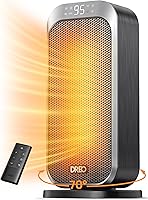
DREO 25 Inch Space Heater: for medium rooms with several seats
Choose the DREO 25 Inch Space Heater for a medium room where side-to-side airflow can serve more than one seat. Its stated coverage is 100–270 sq ft, with 70° oscillation.
Three heat levels, ECO mode and a fan mode give you ways to adjust operation after the room warms. The thermostat spans 41–95°F, with settings in 1°F steps.
This is a sensible fit beside a seating area or across from an office workspace, provided the full airflow path stays clear. At 25 inches tall, it needs a floor position where furniture won't block its outlet.
Skip it if you need the shortest unit or want heat sent in every direction from a central position. It also won't solve a large, unheated room simply because its coverage range reaches beyond the rough wattage estimate.
For an awake evening routine in a bedroom, compare placement and controls in our space heater guide for bedrooms.
DREO 16 Inch Large Room Heater: for small offices with limited floor space
Choose the DREO 16 Inch Large Room Heater when a compact body matters. Its footprint is 6.38 by 6.1 inches, though required clearances make the usable space around it much larger.
DREO gives two coverage figures: 107.6–215.3 sq ft in the specifications and up to 250 sq ft elsewhere. Use about 215 sq ft as the cautious upper comparison point, especially when whole-room warmth matters.
Its digital thermostat, ECO mode, remote and 12-hour timer suit a work session where you'll adjust the heat from your chair. DREO states noise can be as low as 34 dB; that minimum isn't a promise for every operating mode.
Buy it for a small office or a defined occupied area with clear floor space. Skip it for a large open living area, or if you're depending on the higher coverage figure to make the purchase fit.
DREO 30 Inch Oscillating Heater: for wide seating layouts
Choose the DREO 30 Inch Oscillating Heater when you want control over how widely the airflow sweeps. Its adjustable angles are 30°, 60°, 90° and 120°, with stated coverage up to 300 sq ft.
A narrow sweep suits a focused seating area, while a wider sweep can serve people spread across a room. Five heat levels, ECO mode and three fan levels offer more adjustment than the other models here.
Its roughly 30-inch height makes placement worth checking before ordering. Make sure nearby furniture won't obstruct the outlet as it turns, and keep its position clear of routes through the room.
Buy it for a wider layout that benefits from adjustable airflow. Skip it if you expect its taller body to provide more maximum heat than the smaller models, or need warmth carried into separate rooms.
DREO calls for a stable voltage supply. Don't use the heater at an outlet with signs of electrical trouble.
DREO Whole Room Heater: for open layouts with central floor space
Choose the DREO Whole Room Heater when you have an open position where its 360° circular outlet can send warm air around the room. Its stated coverage is 160–270 sq ft.
This design fits a different layout from a tower aimed across the room. DREO calls for an open area 3 ft from walls or other objects to help the heater monitor temperature accurately.
Three heat settings, ECO mode, a remote and a 1–12-hour timer support routine adjustments. Choose it for a shared room where people sit in different directions and the required open space is available.
Skip it if the only usable location is a corner, a narrow gap beside furniture or under a crowded desk. A compact body doesn't cancel the clearance needed around a circular outlet.
How should you set up a space heater for useful warmth?
Place the heater where air can reach the occupied area without crossing clutter or blocked furniture. Safe clearance comes first, followed by airflow and convenient access to a suitable wall outlet.
Before switching it on:
- Read the manual's placement, surface and clearance instructions.
- Check the cord, plug and housing for damage.
- Use a stable, level surface approved by the manual.
- Keep at least 3 ft from bedding, curtains and other combustible items, allowing any greater required clearance.
- Keep the cord out from under rugs and away from walkways.
Plug directly into a suitable wall outlet, never a power strip or extension cord. Our guide to space heaters and extension cords explains why cord reach should influence placement.
Start with a comfortable target temperature and reassess from your usual chair after the room has had time to warm. The sensor sits near the heater, so its reading may differ from the temperature across the room.
If the heater cycles off while your seat remains cold, look for blocked airflow or poor placement before raising the setting. A thermostat can't correct a room layout that keeps warmth away from you.
Does a 1,500-watt heater use a lot of electricity?
A heater running continuously at full power uses 1.5 kilowatt-hours per hour. Over 4 hours at that output, it uses 6 kilowatt-hours.
Actual energy use falls when a thermostat cycles the heat off or a control reduces output. A cold, drafty room may keep the heater running much longer than a smaller room that already receives central heat.
ECO mode can adjust operation around a temperature target, but it doesn't make the room's heat loss disappear. Use a comfortable setting and switch the heater off when the room is no longer occupied.
Compare how many watts a space heater uses with what it can cost to run. Your electricity rate and running time matter more than the height of the heater.
What care and use mistakes should you avoid?
Keep airflow paths clean and stop using a heater that shows damage or electrical trouble. Care helps the heater operate as intended, but it doesn't increase its heating capacity.
Switch it off, unplug it and let it cool before cleaning. Follow the manual for removing surface dust, and don't open the housing or wash internal parts unless the instructions allow it.
Common mistakes include:
- Buying by height: a taller heater may distribute air differently without producing more heat.
- Using coverage as a guarantee: room conditions still determine whether warmth is enough.
- Turning the thermostat to maximum: this won't boost output beyond the heater's limit.
- Blocking the intake or outlet: furniture, dust and fabric can restrict airflow.
- Using a timer as supervision: automatic shutoff doesn't make unattended operation appropriate.
- Ignoring recurring shutoffs: stop and follow the manual rather than repeatedly restarting it.
Turn the heater off before sleeping or leaving the room, and keep children and pets away. Read our space heater safety guide before the first use.
How do you decide what size space heater you need?
Decide what size space heater you need by defining the job first: extra warmth at a seat, supplemental room heat or full heating for a cold space. Then match floor area, room conditions and safe placement to the heater's limits.
Choose the DREO 16 Inch for a smaller office, the DREO 25 Inch for side-to-side airflow in a medium room, or the DREO 30 Inch for a wider seating layout. Choose the Whole Room model when an open central position suits its circular outlet.
If one portable heater can't meet the room's needs, address heat loss and the main heating system before adding more units. For the next step, compare heater types in our best space heaters for home guide.
Frequently asked questions
What size space heater do I need for a 500 sq ft room?
A 500 sq ft room exceeds the stated coverage of all four heaters here; the rough 10-watts-per-square-foot estimate suggests 5,000 watts for planning, but actual needs depend on heat loss and existing heating. Use a portable heater for an occupied zone, or get professional advice for heating the whole room.
How many watts do I need per square foot?
About 10 watts per square foot is a rough starting estimate for heater sizing; it puts a 150 sq ft room at about 1,500 watts, but it isn't a room-specific calculation. Drafts, insulation, ceiling height, outdoor temperatures and the warmth already supplied by central heating can change the requirement.
Is a 1,500-watt heater enough for a bedroom?
A 1,500-watt heater can provide useful extra warmth in a bedroom that fits its coverage and placement requirements; a drafty room or one with high ceilings may need more heat than its floor area suggests. Use the heater while you're awake and present, then turn it off before sleeping.
Can one space heater heat a whole house?
One portable space heater isn't a suitable replacement for a home's heating system; walls, doorways and separate floors limit how warm air spreads, while heat escapes from the building. Use these heaters for extra warmth in one suitable room and consult a qualified heating professional about whole-house heating needs.
Does a larger wattage heater warm a room faster?
Higher wattage supplies more heat when other conditions are equal, so it can shorten warm-up time; airflow, heat loss and room layout also affect the result. All four heaters here have the same maximum output, so a taller body or wider oscillation doesn't mean more heating power.