7 Best Oil-Filled Radiators (October 2026)
The best best oil-filled radiators include the De'Longhi EW7707CM Oil Heater for simple daily heating, the DREO Oil Filled Radiator for shared living rooms, and the DREO Radiator Heater for fine comfort adjustments.
On this page (9 sections)
- Which oil-filled radiator is best for your needs?
- How we chose the best oil-filled radiators
- Compare the best oil-filled radiators
- Best oil-filled radiators by use
- How do you choose an oil-filled radiator for your room?
- How should you set up and use an oil-filled radiator?
- What care does an oil-filled radiator need?
- Which common mistakes waste heat or create problems?
- Which best oil filled radiator pick fits your routine?
The best oil filled radiator for simple daily heating is the De'Longhi EW7707CM Oil Heater. Choose the DREO Oil Filled Radiator if you want remote adjustments and display controls, or Amazon Basics Oil Heater for manual operation in a smaller room.
Oil-filled radiators suit longer stretches of room heating when you want warmth without a blowing fan. They make less sense for a quick burst of heat while you get dressed or briefly use a cold room.
Start with your room, outlet location and daily routine. For options beyond radiators, our guide to the best space heaters for home compares the main heater types.
Our picks at a glance
-
1
-
2

-
3

Which oil-filled radiator is best for your needs?
Choose the EW7707CM for simple operation, the first DREO for convenient room controls, or the second DREO for fine temperature adjustments. The remaining picks serve smaller rooms, regular heating routines or frequent moves.
A timer only helps if it matches how you'll safely use the heater. Likewise, lighter weight matters more when you cross thresholds or carry a radiator than when it stays beside one wall.
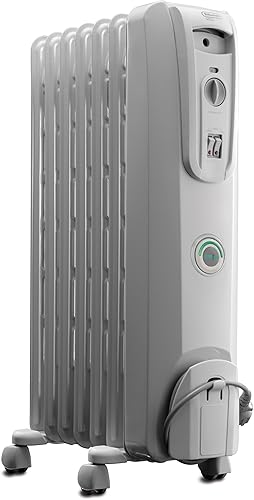
De'Longhi EW7707CM Oil Heater
- 1500W output
- Three heat settings
- ComfortTemp feature
- Sealed oil reservoir
Choose this radiator for straightforward daily adjustments without digital menus. ComfortTemp manages temperature and power, while snap wheels help with moves on the same floor.
Pros
- Simple controls
- ComfortTemp temperature and power management
- Built-in snap wheels
Cons
- 23.2 lb to carry
- No digital temperature selection
DREO Oil Filled Radiator
- Three power levels plus eco
- Remote and touchscreen
- Mute and screen-off modes
- 24-hour timer
Remote adjustments suit a living room where the heater sits away from your chair. Mute, screen-off and child-lock settings add useful control over sounds, light and button presses.
Pros
- Remote control
- Mute and screen-off modes
- Child lock and tip-over protection
Cons
- More settings to learn than manual controls
- Coverage depends on room conditions
DREO Radiator Heater
- Temperature selection in 1°F steps
- Eco mode
- Ambient temperature indicator
- Remote control
Choose this DREO for small changes to a numeric temperature target. Its ambient temperature indicator helps you follow conditions near the heater.
Pros
- 1°F temperature-setting increments
- Ambient temperature indicator
- Remote and 24-hour timer
Cons
- 20.6 lb to carry
- Needs more front-to-back space than the other DREO
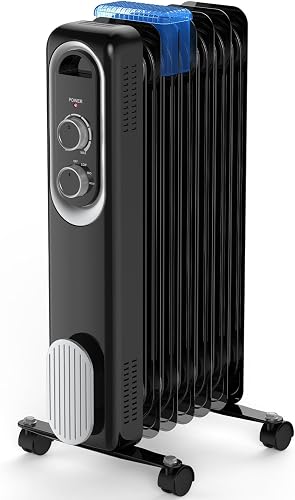
Amazon Basics Oil Heater

- Manual controls
- Adjustable thermostat
- Seven oil-filled fins
- Caster wheels
A practical choice for a small office where you can reach the controls easily. The fan-free design avoids blower noise, and the sealed oil needs no refills.
Pros
- Straightforward manual controls
- Tip-over and overheat protection
- Handle and caster wheels
Cons
- Adjustments require reaching the heater
- Smaller coverage than either DREO
De'Longhi Dragon Oil Heater

- Digital panel and LED display
- 24-hour programmable timer
- ECO Plus feature
- Child lock
The Dragon suits a room with a regular heating routine and a mostly permanent heater location. ECO Plus regulates power and temperature, while front and rear handles help with occasional moves.
Pros
- 24-hour programmable timer
- ECO Plus power management
- Rubber-coated snap wheels
Cons
- Heaviest pick at 26.6 lb
- Less suited to frequent carrying
Sweetcrispy Oil Radiator
- Three power settings
- 13 lb weight
- Four casters and handle
- Manual thermostat
The lightest radiator here suits moves between smaller rooms. Four casters help on level floors, while a carry handle helps when rolling isn't possible.
Pros
- Lowest weight in this group
- Four casters
- Tip-over and overheat protection
Cons
- Manual temperature adjustments
- Coverage aimed at smaller rooms
Hykolity Radiator Heater

- Power-off memory
- Eco mode
- Touch panel and remote
- 24-hour on/off timer
Hykolity's power-off memory restores temperature and timer settings after unplugging or a power interruption. Choose it when keeping those preferences matters more than having a stated coverage figure.
Pros
- Temperature and timer memory
- Remote adjustments
- Child lock and tip-over switch
Cons
- Remote batteries aren't included
- No stated square-foot coverage
How we chose the best oil-filled radiators
We compared control style, room fit, movement and safeguards, giving priority to features that solve a clear daily need. The scores reflect those differences without assuming that more buttons or a larger fin design always means better heating.
All seven models reach the same maximum electrical input. Their useful differences are how you set the heat, manage room temperature and move the unit.
We haven't used promotional heat-dispersion percentages to rank them. Those figures use different comparisons and don't establish which heater will warm your particular room fastest.
Compare the best oil-filled radiators
Compare room fit and control style first, then check whether you can move and place the heater safely. Maximum power alone won't separate these picks.
| Product | Best for | Power | Controls | Room fit | Our score |
|---|---|---|---|---|---|
| De'Longhi EW7707CM Oil Heater | simple daily heating | 1500W | Manual thermostat and ComfortTemp | Small to medium spaces | 8.3 |
| DREO Oil Filled Radiator | shared living rooms | 600W, 900W or 1500W | LED display, touchscreen and remote | 250 sq ft coverage | 8.1 |
| DREO Radiator Heater | fine comfort adjustments | 600W, 900W or 1500W | Digital thermostat and remote | 250 sq ft coverage | 7.8 |
| Amazon Basics Oil Heater | small home offices | 600W, 900W or 1500W | Manual thermostat and heat selector | 150 sq ft coverage | 7.7 |
| De'Longhi Dragon Oil Heater | regular heating routines | 1500W | Digital panel with programmable timer | Small to medium spaces | 7.6 |
| Sweetcrispy Oil Radiator | frequent room changes | 600W, 900W or 1500W | Manual thermostat knob | 107.6–161.5 sq ft coverage | 7.0 |
| Hykolity Radiator Heater | preserving heating preferences | 600W, 900W or 1500W | Touch panel and remote | Confirm suitability for your room | 6.9 |
A room-coverage figure helps narrow the field, but it doesn't account for every ceiling height, draft or outdoor temperature. Treat it as a starting point rather than a reason to ignore your room's conditions.
Best oil-filled radiators by use
Pick the radiator whose daily controls and physical handling fit your routine. Each option below has a clear reason to buy it and a reason to choose something else.
De'Longhi EW7707CM: best oil-filled radiator for simple daily use
The EW7707CM suits someone who wants to adjust the heat without learning digital menus. Its manual thermostat, three heat settings and ComfortTemp function cover the main daily tasks.
De'Longhi EW7707CM Oil Heater
- 1500W output
- Three heat settings
- ComfortTemp feature
- Sealed oil reservoir
Choose this radiator for straightforward daily adjustments without digital menus. ComfortTemp manages temperature and power, while snap wheels help with moves on the same floor.
Pros
- Simple controls
- ComfortTemp temperature and power management
- Built-in snap wheels
Cons
- 23.2 lb to carry
- No digital temperature selection
De'Longhi says ComfortTemp manages temperature and power automatically. That makes it useful for a home office or sitting room where you want a steady routine rather than frequent changes.
The steel body has a permanently sealed oil reservoir, and the built-in snap wheels avoid a separate wheel installation. Use the handle for movement as directed, and let the radiator cool before relocating it.
At 23.2 lb, this is a better choice for rolling around one floor than carrying up stairs. Its thermal cut-off and enclosed heating elements are useful safeguards, but the exterior still needs clearance from people and belongings.
Buy it for uncomplicated daily heating in a small to medium space. Skip it if selecting an exact temperature on a display or adjusting the heater from your chair is central to how you'll use it.
DREO Oil Filled Radiator: convenient controls for shared rooms
The first DREO suits a living room where you want to change settings from your seat. Its remote, touchscreen and large LED display give you several ways to make adjustments.
DREO Oil Filled Radiator
- Three power levels plus eco
- Remote and touchscreen
- Mute and screen-off modes
- 24-hour timer
Remote adjustments suit a living room where the heater sits away from your chair. Mute, screen-off and child-lock settings add useful control over sounds, light and button presses.
Pros
- Remote control
- Mute and screen-off modes
- Child lock and tip-over protection
Cons
- More settings to learn than manual controls
- Coverage depends on room conditions
Mute and screen-off modes are useful when control sounds or display light would distract you. The child lock limits unwanted button presses, though it doesn't protect anyone from touching a hot radiator.
DREO gives this model a 250 sq ft coverage figure. It also includes eco operation, a 24-hour timer, tip-over protection and triple overheat protection.
At 17.6 lb, it is lighter than the second DREO, with wheels and handles for moves between rooms. Check the route and outlet before moving it rather than stretching the cord toward a more convenient spot.
Choose it for remote adjustments and display control. Skip it if everyone using the heater prefers a simple dial, or if you only need brief heat during short visits to a room.
DREO Radiator Heater: smaller temperature-setting steps
The second DREO is the better fit for someone who wants to adjust a numeric temperature target in small steps. Its eco mode offers 41°F to 95°F settings in 1°F increments.
DREO Radiator Heater
- Temperature selection in 1°F steps
- Eco mode
- Ambient temperature indicator
- Remote control
Choose this DREO for small changes to a numeric temperature target. Its ambient temperature indicator helps you follow conditions near the heater.
Pros
- 1°F temperature-setting increments
- Ambient temperature indicator
- Remote and 24-hour timer
Cons
- 20.6 lb to carry
- Needs more front-to-back space than the other DREO
Those increments let you make a modest change instead of turning a dial and guessing. They describe the available settings, not a promise that every corner of a room will stay at the displayed temperature.
An ambient temperature indicator helps you follow conditions near the heater. Eight M-shaped fins, a remote and a 24-hour timer round out the design.
This model needs more front-to-back space than the other DREO and weighs 20.6 lb. Measure the intended position with the required safety clearance, especially if furniture or a doorway limits your choices.
Choose it for fine comfort adjustments, rather than assuming its fin shape means more total heat. Skip it if a manual control is enough, and read the DREO radiator heater review for a closer look at its controls.
Amazon Basics Oil Heater: straightforward heat for a small office
Amazon Basics suits a small enclosed office where the heater's controls are easy to reach. Its manual thermostat and heat selector keep the routine simple.
Amazon Basics Oil Heater
- Manual controls
- Adjustable thermostat
- Seven oil-filled fins
- Caster wheels
A practical choice for a small office where you can reach the controls easily. The fan-free design avoids blower noise, and the sealed oil needs no refills.
Pros
- Straightforward manual controls
- Tip-over and overheat protection
- Handle and caster wheels
Cons
- Adjustments require reaching the heater
- Smaller coverage than either DREO
The stated coverage is 150 sq ft, making it a more natural match for a modest study than an open living and dining area. Fan-free operation avoids blower noise during calls or focused work.
Seven oil-filled fins hold heat, while the sealed oil requires no refilling. Tip-over and overheat protection are included, along with caster wheels and a handle.
A manual thermostat can take a few adjustments to find a comfortable position. Once the room has warmed, make small changes and give them time to work rather than repeatedly turning the control up and down.
Buy it when you want simple local controls. Skip it if the radiator must sit across the room and you'll regularly want to adjust it without leaving your desk.
De'Longhi Dragon Oil Heater: a fit for regular heating routines
The Dragon suits a room you use on a predictable daily routine, with a heater that mostly stays in place. Its digital panel and programmable timer make it easier to repeat your preferred setup.
De'Longhi Dragon Oil Heater
- Digital panel and LED display
- 24-hour programmable timer
- ECO Plus feature
- Child lock
The Dragon suits a room with a regular heating routine and a mostly permanent heater location. ECO Plus regulates power and temperature, while front and rear handles help with occasional moves.
Pros
- 24-hour programmable timer
- ECO Plus power management
- Rubber-coated snap wheels
Cons
- Heaviest pick at 26.6 lb
- Less suited to frequent carrying
ECO Plus regulates power and temperature, so you don't have to manage output only through manual changes. The heater also includes a child lock, thermal cut-off and a sealed oil reservoir.
De'Longhi uses a design intended to increase convection and radiant surface area. Choose it for its controls and room fit rather than expecting a larger surface to create energy beyond its electrical input.
At 26.6 lb, it is the heaviest pick here. Front and rear handles and rubber-coated snap wheels help with moves, but they don't make regular stair carrying convenient.
Choose the Dragon for a consistent routine and mostly fixed location. Skip it for frequent carrying, and use the timer only within the operating instructions and a routine that keeps the heater supervised.
Sweetcrispy Oil Radiator: easier moves between smaller rooms
Sweetcrispy is the strongest fit for someone who regularly moves a radiator between smaller rooms. At 13 lb, it is the lightest model in this group.
Sweetcrispy Oil Radiator
- Three power settings
- 13 lb weight
- Four casters and handle
- Manual thermostat
The lightest radiator here suits moves between smaller rooms. Four casters help on level floors, while a carry handle helps when rolling isn't possible.
Pros
- Lowest weight in this group
- Four casters
- Tip-over and overheat protection
Cons
- Manual temperature adjustments
- Coverage aimed at smaller rooms
Four casters help on level floors, and the carry handle helps where rolling isn't practical. Unplug it and let it cool before moving, even when the destination is only a nearby room.
Its stated coverage is about 108–162 sq ft. That points toward a study or small sitting room rather than a large open space.
The manual thermostat keeps operation direct, while tip-over and overheat protection provide automatic safeguards. Sweetcrispy specifically requires a grounded wall receptacle and rules out extension cords, power strips and multi-plug adapters.
Buy it for lower carrying weight and smaller-room use. Skip it if you need remote changes or fine digital settings, and confirm that each room has a safe outlet and placement area before planning to share one heater between them.
Hykolity Radiator Heater: keeping temperature and timer preferences
Hykolity suits buyers who value keeping their preferred temperature and timer settings after unplugging. Its power-off memory is the main reason to choose it over a simpler radiator.
Hykolity Radiator Heater
- Power-off memory
- Eco mode
- Touch panel and remote
- 24-hour on/off timer
Hykolity's power-off memory restores temperature and timer settings after unplugging or a power interruption. Choose it when keeping those preferences matters more than having a stated coverage figure.
Pros
- Temperature and timer memory
- Remote adjustments
- Child lock and tip-over switch
Cons
- Remote batteries aren't included
- No stated square-foot coverage
Hykolity says the memory function restores those settings after a power interruption as well. Check the controls whenever power returns so the remembered schedule still matches your plans.
The touch panel and remote support adjustments without relying on one control method. The remote needs 2 AAA batteries, which aren't included.
The heater also has eco operation, a 24-hour on/off timer, a child lock, tip-over shutoff and overheat protection. Four casters and a handle support movement on the same floor.
Choose it when saved preferences solve a recurring annoyance. Skip it if you need a stated square-foot coverage figure to narrow your choice, and don't treat memory or automatic controls as permission to leave a portable heater operating unattended.
How do you choose an oil-filled radiator for your room?
Choose by heat demand, safe placement and control style, in that order. A remote or timer won't help if the room loses heat faster than the radiator can replace it.
Match the room before comparing extras
An enclosed room is easier to heat than an open area connected to hallways and stairs. Measure floor area, then consider ceiling height, drafty windows and how much existing heat the radiator will supplement.
A cold room with several outside walls can need more heat than a sheltered room of the same size. Don't expect a coverage number to account for those differences.
For bedroom-specific choices, see our best space heaters for bedrooms. Safe placement can rule out a radiator if the only available spot is close to bedding or curtains.
Separate power settings from thermostat settings
Power controls heat output; the thermostat controls when heat is needed. All seven radiators here have a 1500W maximum, while several provide 600W and 900W options.
A lower power mode uses less electricity during active heating but takes longer to add the same amount of heat. It works best when a room needs a gentle top-up or has already reached a comfortable temperature.
Turning the thermostat far above your target generally won't make the room warm faster at the same power setting. Our guide to space heater wattage explains the connection between input and electricity use.
Choose controls you'll use comfortably
A dial works well when you want a familiar routine and can reach the heater easily. Digital temperature selection helps when several people share the room or you want a repeatable numeric target.
A remote adds convenience, while screen-off and mute options matter if light and sounds bother you. A timer is useful only when you understand its operation and keep heating within a supervised routine.
Check movement and safety separately
Wheels help with level floors, but weight matters at stairs, thick rugs and thresholds. Consider where you'll store the radiator during warmer months as well as where it will run.
Compare overheat and tip-over safeguards for the exact model. Our guide to oil-filled heater safety explains why those features support careful use rather than replacing it.
How should you set up and use an oil-filled radiator?
Set the radiator upright on a stable, level surface, with the clearance required by its manual. Plan the position around a suitable wall outlet before switching it on.
Check that wheels and supports are fitted as instructed. Inspect the cord, plug and body, and don't use a radiator with damage or signs of an oil leak.
Keep it out of doorways and away from furniture, curtains and bedding. Never drape clothing over the fins or use the heater as a drying rack.
Plug directly into the wall, keeping the cord clear of the hot body and walking routes. Our guide to space heaters and extension cords explains why an extension isn't a sound placement fix.
Allow time for the room to warm
Start with a comfortable thermostat target and an appropriate power mode. Oil-filled heaters warm their internal oil and metal body before the room reaches a steady temperature, so avoid judging the result after only a few minutes.
Keep doors and windows closed when practical, while maintaining normal ventilation. Once the room is comfortable, reduce the power setting if the model allows it and the lower output can maintain warmth.
Judge comfort where you sit
A sensor near the radiator can read differently from a desk beside a cold window. Give the room time to settle before making small thermostat changes.
If the room stays cold while the heater runs continuously, check drafts and open connections to other rooms. A higher thermostat target can't increase output beyond the heater's maximum.
Turn the heater off before leaving it unattended or going to sleep. Quiet operation, a timer and automatic shutoffs don't change that routine.
What care does an oil-filled radiator need?
Routine care means keeping the exterior clean and checking for damage, not changing the oil. The oil is a sealed heat-transfer fluid rather than a fuel that burns away.
Switch off, unplug and let the radiator cool before cleaning. Follow its manual, usually using a soft cloth and gentle dust removal around the fins and controls.
Don't open the reservoir or try to top it up. Stop using the heater if you find oily residue, a damaged cord, scorching or a loose plug connection, and seek the manufacturer's guidance.
For storage, let it cool fully and keep it upright in a dry place. Avoid pulling the cord tight around the body or placing heavy objects on it.
Which common mistakes waste heat or create problems?
The biggest mistakes are expecting instant heat, oversizing the task and treating stored warmth as free energy. Avoiding those errors helps you choose the right heater and use it more effectively.
- Heating connected rooms with one portable radiator: open doorways let warmth spread beyond the room you meant to heat.
- Choosing only by maximum watts: controls and room heat loss matter when every option has the same maximum input.
- Turning the thermostat up repeatedly: allow time for each adjustment before changing it again.
- Blocking the radiator: furniture and drying clothes interfere with heat movement and required clearance.
- Moving it while hot: switch off, unplug and allow cooling before changing rooms.
- Confusing a child lock with burn protection: the lock restricts controls, not access to hot surfaces.
Stored warmth continues to leave the radiator after power stops, but that energy came from electricity used earlier. It can make cooling feel gradual without creating extra heat.
For a useful estimate, multiply power in kilowatts by hours of active heating and your electricity rate. Our guide to space heater running costs explains how thermostat cycling changes the calculation.
Which best oil filled radiator pick fits your routine?
The best oil filled radiator is the one that matches your room and daily adjustments. Choose the EW7707CM for simple operation, the first DREO for remote and display convenience, or the second DREO for fine temperature-setting steps.
Amazon Basics fits a small office with easy access to the controls. Pick the Dragon for a regular heating routine, Sweetcrispy for lower carrying weight, or Hykolity when preserving settings matters most.
If you mainly need brief bursts of warmth, compare oil-filled versus ceramic heaters before ordering. For more detail on gradual warm-up and retained heat, read how an oil-filled radiator works.
Our top 3 picks at a glance
-
1
-
2
-
3
Frequently asked questions
What is the best oil filled radiator for most rooms?
The De'Longhi EW7707CM Oil Heater is our top choice for simple daily heating in a small to medium room. Choose the DREO Oil Filled Radiator instead if remote adjustments, screen-off mode and a timer better suit your routine.
Room insulation and safe placement matter more than extra controls.
Do oil-filled radiators use a fan?
Oil-filled radiators generally warm rooms through radiation and natural air circulation rather than a blower. The Amazon Basics, Sweetcrispy and both De'Longhi models here explicitly offer fan-free heat.
You avoid fan noise, but switches and metal expanding or cooling can still make sounds, so complete silence isn't assured.
Can an oil-filled radiator heat a large room?
An oil-filled radiator can help heat a larger enclosed room, but its output must match the room's heat loss. Both DREO models here have stated coverage of 250 sq ft.
Drafts, high ceilings and open doorways change the result; compare options in our large-room space heater guide.
Are oil-filled radiators cheaper to run?
Oil-filled radiators aren't automatically cheaper to run than other electric resistance heaters at the same power and operating time. Savings depend on temperature settings, thermostat cycling and how much space you heat.
Our guide to oil-filled heater electricity use explains why heater type alone doesn't determine your bill.
What safety features should you look for?
Look for overheat protection and tip-over shutoff, then check the instructions for the exact model you choose. A child lock only limits setting changes and doesn't prevent burns.
Follow our space heater safety guide, maintain required clearances and turn the heater off before leaving it unattended or going to sleep.