6 Best Space Heaters With Thermostat (October 2026)
The best space heaters with thermostats include the DREO 1500W Thermostat Heater for daily room heating, the DREO 25 Inch Space Heater for shared living rooms, and the Lasko Digital Tower Heater for simple heating routines.
On this page (10 sections)
- How we chose space heaters with thermostats
- Which space heater with a thermostat fits your room?
- What should you check in a space heater thermostat?
- How much heater does your room need?
- How do you set up a thermostat heater?
- Do thermostats make space heaters cheaper to run?
- Which mistakes reduce comfort or create avoidable problems?
- How should you clean and store a thermostat heater?
- Which thermostat space heater should you choose?
- Related space heater guides
The DREO 1500W Thermostat Heater is our top space heater with thermostat for regular room heating, thanks to its automatic power adjustment and oscillation. Choose the DREO 25 Inch Space Heater for fine temperature changes and a child lock, or the portable DREO for frequent moves.
The right thermostat heater should suit both your room and your routine. A clear temperature setting helps, but usable floor space, airflow, controls and safe outlet access matter just as much.
All 6 heaters here have the same maximum heat output. Their main differences are how they control and distribute that heat, how much space they occupy and how easily you can move them.
For other heater types, see our guide to the best space heaters for home. Our best ceramic tower heaters guide focuses on similar fan-driven designs.
Our picks at a glance
-
1

-
2

-
3
- 4
 Check it
DREO 16 Inch Large Room Heater
Best for smaller home offices - 5
 Check it
DREO Portable Thermostat Heater
Best for moving between rooms - 6
 Best for larger sitting areasCheck it
How we chose space heaters with thermostats
We prioritized useful temperature controls, automatic operation and practical room placement over the longest feature list. A heater earns its place here by fitting a clear need, such as simple controls, shared-room use or easy carrying.
We compared thermostat settings, heat modes, timers, dimensions and safety features. The scores reflect those features and each heater's fit for this roundup.
Coverage estimates help narrow the choices, but room insulation and drafts can change the result. Likewise, a selectable 1°F step describes the control, rather than a promise of equal temperatures across the room.
| Product | Best for | Heat output | Temperature range | Controls | Our score |
|---|---|---|---|---|---|
| DREO 1500W Thermostat Heater | daily room heating | 1500 watts | 41°F to 95°F | Thermostat, ECO mode, remote | 8.9 |
| DREO 25 Inch Space Heater | shared living rooms | 1500 watts | 41°F to 95°F | Thermostat, ECO mode, remote | 8.6 |
| Lasko Digital Tower Heater | simple heating routines | 1500 watts | Adjustable thermostat, remote | 8.5 | |
| DREO 16 Inch Large Room Heater | smaller home offices | 1500 watts | 41°F to 95°F | Digital thermostat, remote | 8.4 |
| DREO Portable Thermostat Heater | moving between rooms | 1500 watts | 41°F to 95°F | Thermostat, remote, ECO mode | 8.3 |
| Pelonis 30 Inch Tower Heater | larger sitting areas | 1500 watts | 40°F to 95°F | Digital thermostat, remote | 7.7 |
Which space heater with a thermostat fits your room?
Choose the DREO 1500W Thermostat Heater for regular heating with automatic power adjustment. The remaining picks suit buyers who place more value on a particular size, control layout or carrying routine.
DREO 1500W Thermostat Heater
- 41°F to 95°F thermostat
- ECO adjusts between 1000W and 1500W
- 70° oscillation
- 12-hour timer
Choose this for regular heating in an occupied room, with ECO mode adjusting power as conditions change. Oscillation and a remote suit a shared sitting area or home office.
Pros
- Automatic power adjustment in ECO mode
- Remote and 12-hour timer
- Tip-over and overheat protection
Cons
- Lower ECO power level is still 1000W
- Larger than the 10-inch portable option
1. DREO 1500W Thermostat Heater: our top space heater with thermostat
Buy this DREO if you want to set a comfortable target and let ECO mode adjust power as the room warms. Its 1000W and 1500W ECO levels make the automatic heat adjustment clear.
The thermostat spans 41°F to 95°F, while 70° oscillation spreads airflow across a seating or work area. A remote and 12-hour timer suit an occupied room where you want occasional changes without getting up.
At about 15.8 inches tall, it fits between the shortest portable model and the full-height towers. DREO gives a coverage estimate of 270 sq ft, making it a candidate for an enclosed room with modest heat loss.
DREO identifies it as ETL-certified, with tip-over protection, overheat protection and power-off after 24 hours without interaction. That automatic shutoff is a backup feature, not a reason to leave it running unattended.
Skip this model if carrying weight is your main concern or you specifically want a child lock. Also remember that its lower ECO level still draws substantial power while heating, so an easy thermostat setting matters more than choosing the highest target.
DREO 25 Inch Space Heater
- 41°F to 95°F thermostat in 1°F steps
- H1, H2, H3 and ECO heating modes
- 70° oscillation
- Child lock
A good fit for a living room where people want small temperature changes from their seats. The child lock helps prevent control changes, while separate heat modes offer more choice.
Pros
- 1°F temperature adjustments
- Child lock
- Separate fan mode
Cons
- Needs space for a 25-inch tower
- Less convenient for frequent carrying than the portable DREO
2. DREO 25 Inch Space Heater: for shared living rooms
Choose this tower for a shared living room where small temperature changes and remote control will get regular use. Its 1°F settings let you make a modest adjustment instead of switching between feeling too warm and too cool.
The thermostat range is 41°F to 95°F, with H1, H2, H3 and ECO heating modes. A separate fan mode moves air without adding heat, and 70° oscillation broadens the airflow sweep.
The child lock is useful where accidental button presses are a concern. It does not prevent contact with hot parts or replace keeping children away from the heater.
DREO specifies sound as low as 25 dB, which makes this worth considering for people sensitive to fan noise. Expect sound to vary with the operating mode and room, rather than assuming that figure applies at every setting.
The tradeoff is its 25-inch height and 7.3 lb weight. Skip it if you need a short heater that is easy to carry several times a day, or if your only available position crowds furniture or a walkway.
Lasko Digital Tower Heater
- Adjustable thermostat
- Two heat settings
- 1–8 hour timer
- Oscillation and remote
Pick this for straightforward high or low heat, an adjustable thermostat and an automatic shutoff timer. The remote has a storage spot on the back.
Pros
- Straightforward two-level heat control
- Remote controls thermostat, timer and oscillation
- Comes fully assembled
Cons
- Timer stops at 8 hours
- Fewer heat levels than the 25-inch DREO
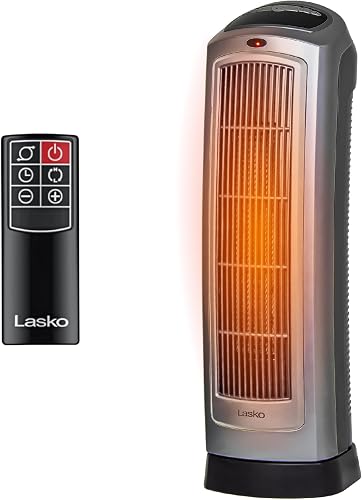
3. Lasko Digital Tower Heater: for simple heating routines
Choose the Lasko if you want high or low heat, an adjustable thermostat and a timer without sorting through several named heating modes. It suits a steady routine, such as warming a sitting area while you read.
The remote adjusts the thermostat, timer and oscillation, as well as switching the heater on or off. Its rear remote storage is a useful detail if you prefer to keep the controls with the heater when moving it.
The timer runs from 1 to 8 hours in one-hour steps. Set it for the period you expect to remain in the room, then switch the heater off yourself if you leave earlier.
This 23-inch tower arrives fully assembled and includes a carry handle. Lasko describes a cool-touch exterior and ETL listing, and it includes overheat protection.
Skip it if you specifically want the documented 1°F adjustments offered by several DREO models. Also choose another option if confirmed tip-over protection is a requirement: that feature is not specified for this Lasko in the information available here.
DREO 16 Inch Large Room Heater
- 41°F to 95°F thermostat in 1°F steps
- 70° oscillation
- ECO mode
- 24-hour auto-off
This shorter tower suits an office with a clear floor position near a suitable outlet. Fine temperature steps, ECO mode and a remote support a regular workday routine.
Pros
- 1°F temperature adjustments
- Shorter than the full-height towers
- 12-hour timer and remote
Cons
- Published coverage figures differ
- Heavier than the portable DREO
4. DREO 16 Inch Large Room Heater: for smaller home offices
Choose this DREO for a home office where a shorter tower fits the available floor position better than a full-height model. It combines digital thermostat control with a remote, so adjustments need not interrupt your work.
The heater is 15.83 inches tall and weighs 5.1 lb. Its thermostat adjusts from 41°F to 95°F in 1°F steps, with ECO mode and a 12-hour timer for managing a work session.
The 70° oscillation can spread airflow across more of the room. If the warm stream feels distracting at your chair, change the heater's position within the manual's placement rules rather than blocking the outlet.
DREO's coverage figures differ: one estimate reaches 250 sq ft, while another spans about 108 to 215 sq ft. Choose it for a smaller enclosed office rather than relying on the largest figure for a drafty room.
Tip-over protection, overheat protection and a separate 24-hour auto-off function are included. Skip it if the main task is heating an open living area, or choose the lighter portable DREO if you expect frequent room changes.
DREO Portable Thermostat Heater
- 41°F to 95°F thermostat in 1°F steps
- Carry handle and 3 lb weight
- ECO and fan-only modes
- 12-hour timer
The lightest option here suits someone who heats an office during the day and a sitting room later. Its short body includes a handle, plus digital temperature control.
Pros
- Lightweight at 3 lb
- Child lock and memory function
- Remote and mute setting
Cons
- Coverage estimate is limited to 200 sq ft
- Oscillation is not specified
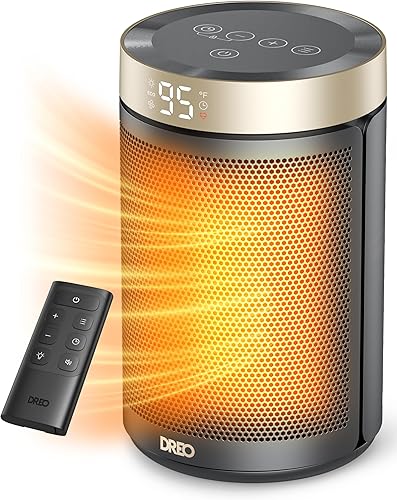
5. DREO Portable Thermostat Heater: for moving between rooms
Choose this portable DREO if you warm different rooms at different times. Its 3 lb weight, carry handle and 10-inch height make it the easiest option here to carry and store.
The thermostat adjusts from 41°F to 95°F in 1°F steps. Power heat, ECO and fan-only modes cover heating and air circulation, while the remote, mute setting and memory function add useful control choices.
A child lock helps prevent setting changes, and DREO identifies the heater as ETL-certified with tip-over and overheat protection. The 12-hour timer is useful for a planned heating period while you remain nearby.
DREO gives a coverage estimate of 200 sq ft. Its small body still has the same maximum output as the larger towers here, so it needs the same care with outlet choice and clear space.
Skip it if you want a confirmed oscillating model to sweep warm air across several seats. For moving it safely, switch it off, unplug it and let it cool before carrying it to another room.
Pelonis 30 Inch Tower Heater
- 40°F to 95°F thermostat with 1°F adjustments
- High, low, ECO and fan modes
- 75° oscillation
- 12-hour timer
Consider this for a sitting area with room for a tall tower and a broad airflow sweep. Its height changes the format, while maximum output matches the smaller heaters here.
Pros
- 75° oscillation
- 1°F thermostat adjustments
- Remote and 12-hour timer
Cons
- Tallest option in this group
- Less compelling for noise-sensitive buyers
6. Pelonis 30 Inch Tower Heater: for larger sitting areas
Consider the Pelonis for a sitting area with a clear floor position and several places where people sit. Its 75° oscillation offers a broad sweep, while the tall body may suit your room layout better than a short heater.
The digital thermostat covers 40°F to 95°F in 1°F adjustments. High, low, ECO and fan modes provide a choice between fixed heat levels, automatic regulation and air movement without heat.
A remote and 12-hour timer let you manage it from your seat. Pelonis includes tip-over protection, overheat protection and V0 flame-retardant materials.
Pelonis gives a coverage estimate of up to 280 sq ft. Choose it for supplemental heating in an enclosed sitting area, rather than expecting its 30-inch height to overcome major drafts or an open floor plan.
Skip it if low fan noise is your first concern. Pelonis specifies operation below 55 dB, while several DREO options provide lower minimum noise figures; those figures are not a matched comparison, but the DREO models are the stronger shortlist for a quiet workspace.
What should you check in a space heater thermostat?
Check temperature selection and heat regulation separately. The thermostat sets the target, while the selected mode determines how the heater works toward it.
Temperature steps help you fine-tune comfort
A digital control with 1°F steps is useful when a small change makes the difference between comfortable and too warm. It also makes returning to a familiar target easier.
The displayed setting does not mean every part of the room has reached that temperature. A sensor near the heater can read differently from the air beside a window or at your chair.
ECO mode changes how the heater operates
ECO mode generally adjusts heating in response to room temperature, but its behavior varies by model. Check the available heat levels and controls instead of assuming every ECO button does the same thing.
Fixed high or low heat can be useful for a brief warmup. For a longer occupied session, thermostat regulation helps avoid repeated manual changes as the room warms.
A timer controls duration, not comfort
A timer switches the heater off after a selected period. It does not replace the thermostat, which responds to temperature.
Use the timer as a reminder and backup for a planned session. If you finish early, turn the heater off rather than leaving it running until the timer ends.
How much heater does your room need?
Choose around room size, heat loss and safe placement, rather than tower height. Every model here reaches 1500W, so a taller body does not automatically provide more heat.
A closed office with normal ceiling height is an easier job than an equally sized room with tall ceilings, leaky windows and an open stairway. Heat escaping into nearby spaces can keep the thermostat calling for heat.
Measure the room's length and width, then consider where the warmth can escape. Our guide to what size space heater you need explains how room conditions affect the choice.
Coverage estimates are most useful for narrowing a shortlist. Do not choose a heater right at its largest stated room size if the space is unusually cold or drafty.
Also measure the usable floor area near a suitable outlet. A narrow base still needs clear space around the heater, and oscillation needs an unobstructed path across its sweep.
If a room never reaches a comfortable temperature, raising the target again will not increase the heater's maximum output. Reduce avoidable drafts where practical or reassess whether portable supplemental heat suits that space.
How do you set up a thermostat heater?
Start with safe placement, direct wall power and a moderate target. Then give the room time to warm before making small adjustments.
- Read the manual first. Confirm the allowed surface, clearances, outlet requirements and control behavior for your exact model.
- Choose a stable position. Keep it away from bedding, curtains, furniture and busy walking routes.
- Inspect the cord and plug. Do not use the heater if either is damaged or the plug fits loosely.
- Connect directly to a suitable wall outlet. Avoid power strips, adapters and extension cords.
- Select a comfortable target. Use thermostat or ECO operation as directed, and adjust gradually once you can judge the room.
Do not route the cord under a rug, pinch it behind furniture or stretch it across a doorway. If the cord cannot reach safely, choose another position.
For more detail on outlet access, read whether you can plug a space heater into an extension cord. A convenient-looking cord arrangement is not worth a poor electrical connection.
Let comfort at your seat guide later changes. If the heater repeatedly stops while your chair remains cold, check for blocked airflow or an unsuitable position before selecting a much higher temperature.
Stop using it if you notice a loose connection, scorching, a burning smell or unusual heat at the plug or outlet. Have an outlet problem checked before reconnecting the heater.
Do thermostats make space heaters cheaper to run?
A thermostat can reduce time spent heating, but savings depend on how much heat the room needs. A high target in a drafty room can keep the heater working for long periods.
At full output, a 1500W heater uses 1.5 kWh in one hour. Multiply the electricity used by your rate per kWh to estimate the energy charge for that period.
For example, 4 hours of continuous full-power heating uses 6 kWh. Thermostat cycling or lower-power operation can reduce that total, but 4 hours switched on does not always mean 4 hours at maximum output.
Use our guide to space heater running costs to estimate use for your electricity rate. For the difference between power and energy, read how many watts a space heater uses.
The useful habit is to heat the occupied space to a comfortable setting and stop when you leave. An ECO button does not guarantee savings if the heater runs longer or supplements unchanged whole-home heating.
Which mistakes reduce comfort or create avoidable problems?
The main mistakes are overheating the target, crowding the heater and confusing automatic features with supervision. Avoid these habits before deciding that you need a different model.
- Setting the thermostat to maximum for faster warmth. A higher target usually extends heating time; it does not raise output beyond the selected mode's limit.
- Putting the heater behind furniture. Restricted airflow can leave the seat cold while heat builds up near the unit.
- Choosing by height alone. Tall and compact models here share the same maximum wattage.
- Treating a child lock as a physical barrier. It controls buttons, not access to the heater or cord.
- Leaving heat running because a timer is set. Switch it off when you leave, even if automatic shutoff is scheduled.
- Using fan-only mode as air conditioning. It moves room air without actively cooling it.
Avoid repeated large thermostat changes as well. Pick a reasonable target, allow the room to respond and make a small correction if needed.
How should you clean and store a thermostat heater?
Keep air openings free of dust and inspect the cord during routine care. Dust buildup can restrict airflow, so follow the manual's cleaning method before performance drops.
Switch the heater off, unplug it and let it cool fully before cleaning. Use only the exterior cleaning tools and methods the manual allows.
Do not spray cleaner into the vents, immerse the heater or open its housing for routine care. If accessible dust cannot be removed as directed, seek service guidance rather than reaching inside.
Before storage, clean and dry the exterior, inspect the cord and keep the unit protected from dust and moisture. Avoid tight cord bends or placing heavy items on the heater.
When bringing it back into use, check its condition and placement again. A different furniture layout can turn last season's clear position into a crowded one.
Which thermostat space heater should you choose?
Choose your space heater with thermostat by routine: how long you sit in the room, how often you move it and which controls you will actually use. Use these final decision rules to narrow the choice.
- Regular heating in one occupied room: choose the DREO 1500W Thermostat Heater for its clear ECO power adjustment.
- A shared living room: choose the DREO 25 Inch Space Heater for fine temperature changes, several heat modes and a child lock.
- A simple heat-and-timer routine: choose the Lasko Digital Tower Heater.
- A smaller home office: choose the DREO 16 Inch Large Room Heater when a shorter tower suits the floor space.
- Frequent room changes: choose the DREO Portable Thermostat Heater for easier carrying.
- A larger sitting area with room for a tall tower: consider the Pelonis for its broad oscillation.
Before ordering, settle on a safe position and check the outlet access. Our space heater safety guide is the useful next step once you have a shortlist.
Related space heater guides
Use these guides to explore heater types, bedroom needs and energy use. They help if your decision extends beyond thermostat controls.
- Best Ceramic Tower Heaters
- Best Space Heaters for Home
- Best Space Heaters for Bedrooms
- Best Energy Efficient Space Heaters
Our top 3 picks at a glance
-
1
-
2
-
3
Frequently asked questions
What does a thermostat do on a space heater?
A thermostat regulates heating around a temperature you choose, reducing the need for repeated manual changes. Depending on the model and mode, the heater may cycle its heat or change power levels.
The sensor measures conditions near the heater, so a chair across the room may feel warmer or cooler.
Is a digital thermostat better than a dial?
A digital thermostat is better if you want a clear temperature target and small setting changes. A dial can suit someone who prefers a simple warmer-or-cooler control.
Digital settings do not guarantee exact room-wide temperature, so judge comfort where you sit rather than relying only on the display.
Can a thermostat space heater lower electricity use?
A thermostat can reduce electricity use by limiting heating once the room reaches its target. Savings depend on heat loss, the chosen temperature and how long the heater runs.
Our guide to space heater electricity use explains why maximum wattage alone does not tell you the total energy used.
Where should you place a space heater with a thermostat?
Place it on a firm, level surface in a clear area, following its manual's placement and clearance requirements. Keep bedding, curtains, furniture and foot traffic away, and leave the inlet and outlet open.
Read our space heater safety guide before choosing its position or connecting it to power.