6 Best Space Heaters for Bedrooms (October 2026)
The best bedroom space heaters include the DREO Quiet Space Heater for evening reading, the DREO Portable Remote Heater for shared room duties, and the DREO Smart Wall Heater for tight floor plans.
On this page (8 sections)
- Best space heaters for bedrooms by use
- How we compared these bedroom heaters
- How to choose the best space heater for your bedroom
- What noise, thermostats and ECO modes mean in practice
- How to set up a bedroom heater before the first use
- Common bedroom heater mistakes to avoid
- How to care for a bedroom space heater
- Which bedroom space heater should you choose?
The DREO Quiet Space Heater is the best space heater for most bedrooms because it combines remote control, a thermostat and oscillating airflow in a compact tower. Choose the DREO Smart Wall Heater for a fixed location, or the Vornado AVH10 Heater if you want automatic heat and airflow adjustments.
Buy for the time you spend reading, dressing or working in your bedroom while awake. A heater that fits safely beside your furniture is more useful than one with extra controls but nowhere suitable to go.
Our picks at a glance
-
1

-
2

-
3

Best space heaters for bedrooms by use
The DREO Quiet Space Heater suits the widest range of bedroom routines here. The alternatives make sense when carrying weight, wall mounting, room layout or automatic controls matter more.
Best space heater for bedroom reading: DREO Quiet Space Heater
DREO Quiet Space Heater
- 34 dB stated minimum noise level
- 1500W PTC heating
- 70-degree oscillation
- 41–95°F thermostat
A portable bedroom pick for reading and relaxing, with a remote and oscillation to adjust warmth from your chair. DREO states a minimum noise level of 34 dB.
Pros
- Low stated minimum noise level
- Remote and child lock
- Floor or tabletop placement
Cons
- Fan sound may bother noise-sensitive readers
- Needs clear space around its air path
Choose this DREO for evening reading and relaxing when you want to change the heat without getting up. Its remote and adjustable airflow make it a practical starting point for a bedroom with one main sitting area.
DREO states noise as low as 34 dB, which makes this model worth considering if fan sound distracts you. That minimum does not describe every heat setting, so allow for more noticeable sound when the heater works harder.
The tower measures 6.77 in deep and wide and 14.65 in tall. Floor or tabletop placement gives you options, provided the manual permits the chosen surface and you can keep the full clearance area empty.
Use oscillation when warmth needs to reach both a chair and an open part of the room. A steady direction may be more comfortable when a moving stream of warm air keeps passing across your face.
Skip it if carrying the heater between rooms is your main need, or if you have no clear placement area away from bedding. A small base still needs a much larger safe space around it.
DREO Portable Remote Heater: for moving between daily tasks
DREO Portable Remote Heater
- Carry handle and 3 lb weight
- 1500W PTC ceramic heat
- 41–95°F thermostat
- Power, ECO and fan-only modes
A handled heater for moving between a bedroom and home office. Mute, memory and remote controls suit frequent changes in routine.
Pros
- Handle makes it easier to carry
- Mute and memory functions
- Fan-only mode
Cons
- Needs a suitable outlet in each room
- Requires cooling before moving or storing
Choose the DREO Portable Remote Heater if one heater will serve several rooms during the day. Its carry handle and 3 lb weight make it a more natural choice for that routine than a fixed wall unit.
It also suits a bedroom that becomes a home office each morning. Power, ECO and fan-only modes let you change how it operates as the room warms, rather than repeatedly switching between full heat and off.
The mute function is useful when control beeps would interrupt reading or a call. Memory can reduce repeated adjustments, but check the controls each time you reconnect it instead of assuming the previous setting is appropriate.
At 11.02 in tall, it takes less vertical space than the taller towers here. That does not make a crowded nightstand or the space beneath a desk a suitable location.
Skip this model if you want a permanent heating spot or all-direction airflow. Before moving it, switch it off, unplug it and let it cool according to its instructions.
DREO Smart Wall Heater: for a permanent bedroom location
DREO Smart Wall Heater
- 120-degree oscillation
- 41–95°F thermostat
- DREO app and voice control
- 24-hour timer
Wall mounting keeps the heater off the floor, while app scheduling suits a regular bedroom routine. Installation still requires a clear wall location near a suitable outlet.
Pros
- Keeps floor space clear
- App scheduling and voice control
- Automatically adjusts panel brightness
Cons
- Requires wall installation
- Unsuitable for frequent moves between rooms
Choose the DREO Smart Wall Heater when usable floor space is scarce and you can provide a suitable wall location. This is the pick for a stable room layout, rather than a heater you move to follow your chair.
The DREO app supports schedules, and Alexa and Google Home compatibility add voice control. Those controls help with a regular routine while you're home and awake; remote access is not a reason to operate the heater in an empty home.
The panel automatically adjusts its brightness in low light. That suits people who dislike a bright control display while winding down, although it does not establish that the room will be completely dark.
Mounting accessories and a drilling guide are included. Check the required wall surface, installation position, outlet access and clearances before making holes.
Skip it if you cannot drill, expect to rearrange the bedroom often or have curtains covering the available wall. For more choices centered on temperature controls, compare our space heaters with thermostats.
Pelonis 23 Inch Tower Heater: for a clear, wider bedroom
Pelonis 23 Inch Tower Heater
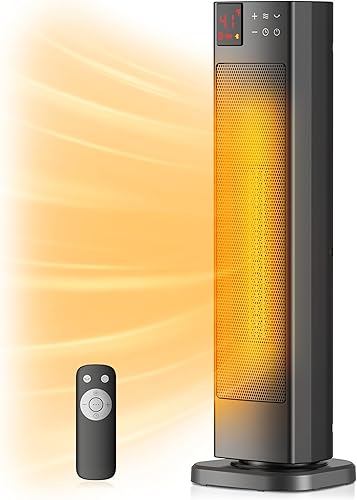
- 1500W ceramic heat
- 75-degree oscillation
- 220 sq ft stated coverage
- 12-hour timer
A taller tower for bedrooms with room for a clear airflow path. Its remote, digital controls and ECO mode suit adjustments during an evening at home.
Pros
- Oscillating airflow
- Remote and digital panel
- High, low, ECO and fan modes
Cons
- Taller body needs careful placement
- Below-55 dB noise claim offers limited guidance for sensitive listeners
Choose the Pelonis tower for a wider bedroom with an open airflow path and space for a taller heater. Pelonis states coverage up to 220 sq ft, making room size a useful first check before considering its controls.
The tower stands 23 in tall and oscillates through 75 degrees. Place it where furniture will not block the moving air stream, rather than assuming extra height lets it heat around a dresser.
Its digital panel and remote offer direct control without an app. High and low heat settings, ECO mode and fan operation give you ways to adjust comfort as the room changes.
Pelonis states operation below 55 dB. That broad limit is less helpful for a noise-sensitive buyer than a figure tied to a specific setting, so this would not be our first choice for someone easily distracted by fans.
Skip it if your bedroom is crowded or quiet operation is the deciding factor. Our quiet space heater picks offer a more focused comparison for that priority.
Vornado AVH10 Heater: for automatic comfort adjustments
Vornado AVH10 Heater

- Automatic climate control
- Two heat settings
- Fan-only mode
- Tip-over protection and safety shut-off
Automatic climate control adjusts both power and airflow as the room changes. Choose it when maintaining a chosen temperature matters more than app scheduling.
Pros
- Automatically adjusts power and airflow
- Fan-only mode
- Vornado-described cool-touch exterior
Cons
- Broad, deep body needs placement space
- Certified and warrantied for U.S. use only
Choose the Vornado AVH10 if you dislike changing settings as the room warms. Its automatic climate control adjusts both power and airflow to maintain your chosen temperature.
That difference matters when a bedroom starts cold but needs less heat later. Rather than supplying the same airflow continuously, the heater manages its output as conditions change.
Vornado uses Vortex Heat Circulation to distribute warmth through small to medium spaces. Give that circulating air a clear path instead of placing the heater behind furniture or aiming it into a bed frame.
The body measures 11.63 in deep, 9.25 in wide and 12 in tall. Its depth deserves attention when measuring a placement spot, especially beside a narrow walkway.
Vornado describes a cool-touch exterior and includes tip-over protection and a safety shut-off. Keep it out of reach of children and pets regardless of those features.
Skip it if app scheduling is essential or you need a narrow tower footprint. It is also certified and warrantied for U.S. use only, which matters if you plan to use it elsewhere.
DREO Whole Room Heater: for space around every side
DREO Whole Room Heater

- 360-degree air outlet
- 25 dB stated noise level
- 1500W PTC heat
- 41–95°F thermostat
A circular air outlet suits an open bedroom with usable space around the heater. DREO advises an open location 3 ft from walls or other objects for accurate temperature sensing.
Pros
- Distributes air in all directions
- Remote and timer
- Three heat settings plus ECO
Cons
- Needs substantial open space around it
- Built-in ambient light may not suit every preference
Choose the DREO Whole Room Heater if your bedroom has open space around the heater, rather than just a narrow gap beside furniture. Its circular outlet sends warm air in every direction.
DREO states coverage of 160–270 sq ft and a noise level of 25 dB. Those figures make it worth considering for a quiet room, but they do not prove it will be quieter or warmer than every alternative in your layout.
The most important buying detail is placement. DREO advises an open area 3 ft from walls or other objects so the heater can monitor temperature more accurately.
That requirement can rule it out in a furnished bedroom even when the room's total area fits the coverage estimate. Mark the intended location before ordering and check whether it blocks the route between the bed and door.
Three heat settings and ECO mode provide output choices, while the remote saves trips across the room. Consider whether its built-in ambient light suits your preferences, and skip this design if the only available spot is against a wall.
How we compared these bedroom heaters
We compared placement, controls, noise claims and airflow design to identify which bedroom routine each heater suits. A model earns its place here by solving a specific need, such as freeing floor space or reducing manual adjustments.
Most of these heaters use a similar maximum electrical input, so extra controls do not automatically mean more available heat. Room fit and how that heat reaches you matter more than a long feature list.
We also separated brand claims from practical buying decisions. A coverage estimate helps narrow the field, while a measured placement area tells you whether the heater can actually work in your bedroom.
How to choose the best space heater for your bedroom
Choose by safe placement first, room needs second and controls third. This order prevents you from buying a feature-rich heater that cannot sit where you need it.
Start with the usable space around the heater
Measure the bedroom's length and width, then identify a location with the clearances required by the heater's manual. The room's total square footage and the available heater location are separate checks.
A bedspread hanging over the edge, an opening closet door or curtains moving in a draft can shrink that location. Leave a clear walking route so a nighttime trip does not bring someone into contact with the heater or cord.
For a wall model, check the installation area with the furniture in its normal position. Wall mounting frees floor space, but the warm-air outlet still needs room.
Match heat output to the room's heat loss
The 4 DREO heaters and the Pelonis use 1500W heating systems. Their different shapes and controls affect heat delivery, but they do not turn that shared maximum input into unlimited room coverage.
A drafty window, poorly insulated exterior wall or high ceiling increases the work needed to maintain comfort. A heater may feel effective near a chair while the far side of the bedroom stays cooler.
For a large or difficult room, compare our space heaters for large rooms before buying. Our guide to how many watts a space heater uses explains the electrical side.
Decide whether moving air will bother you
Every pick here uses a fan to distribute heat. Think about both the sound and the feeling of airflow while you read, get dressed or work.
Oscillation spreads a moving stream across a wider area, while a circulating design aims to mix room air. Neither approach guarantees that furniture will not create cooler spots.
If you dislike any fan sound, broaden your search beyond these picks. Our oil-filled heater vs ceramic heater guide explains the tradeoff between slower, fanless warmth and quicker fan-assisted heat.
Choose controls around your routine
A remote is useful when the heater sits across from your chair. App scheduling is more relevant when you use the same bedroom at predictable times.
A thermostat is worth prioritizing over a long timer because it responds to temperature rather than just elapsed time. Set it for comfortable room warmth, then use a timer as a backup stopping point while you remain awake.
For a broader comparison of heater types and room needs, read how to choose a space heater.
What noise, thermostats and ECO modes mean in practice
Noise figures, temperature steps and ECO labels describe different parts of comfort. Use each for its intended purpose instead of treating any one as proof that a heater will suit your bedroom.
Minimum noise is not the sound at every setting
A stated minimum noise level usually describes a favorable operating condition. Higher airflow, control beeps, oscillation movement and changing fan speed can all affect what you notice.
A quiet bedroom can also make small sounds stand out more than a busy living room would. If you are sensitive to changing sounds, consider the mute controls and airflow behavior along with the noise number.
A precise setting is not a uniform room temperature
A thermostat adjustable in 1°F steps lets you make small changes to the setpoint. It does not mean the air beside your pillow and the air near the heater will match exactly.
The sensor reads conditions near the unit, which is why blocked airflow and cramped corners can cause poor control. Give the heater time to settle before repeatedly changing the target.
ECO mode manages operation, not the cost of electricity
ECO mode can reduce unnecessary heating by adjusting operation around a target temperature. Its value depends on how much heat the room needs and how long the heater runs.
Raising the thermostat far above your comfort level can keep a heater working longer without making the bedroom useful any sooner. Compare our energy-efficient space heater guide for controls that help manage use.
How to set up a bedroom heater before the first use
Read the manual and prepare the location before plugging the heater in. Bedroom clutter makes this step especially important because fabric and cords can move after you finish setting up.
- Choose a stable location. Use a level surface allowed by the manufacturer, with the required clearance around the heater.
- Remove nearby fabric. Check bedding, curtains, laundry, rugs and clothes hanging from furniture.
- Plan the cord route. Keep it out of walkways and away from doors that could pinch it.
- Check the outlet fit. The plug should fit securely, with no damaged outlet face or loose connection.
- Start while you are present. Learn the controls and observe how the airflow reaches the room.
- Set a modest target. Adjust for comfort after the room has had time to warm.
Plug the heater directly into a suitable wall outlet. Do not use a power strip, and read our guide to space heaters and extension cords before considering any cord workaround.
Avoid running another high-draw appliance on the same circuit. If a breaker trips repeatedly, stop and resolve the electrical load rather than repeatedly resetting it.
Stop using the heater if the plug or outlet becomes unusually hot, the cord is damaged or there is a burning smell. Our space heater safety guide covers placement and electrical precautions in more detail.
Common bedroom heater mistakes to avoid
The biggest mistakes are choosing by coverage alone, blocking airflow and using automation as supervision. Small changes in placement and routine often matter more than another heat mode.
Putting a compact heater too close to the bed
A short tower can look harmless beside a nightstand, but blankets may fall or shift into its clearance area. Place the heater where ordinary use of the bed will not bring fabric near it.
Do not put a heater on a bed or other soft surface. A stable base and clear inlet are basic requirements even for a small model.
Hiding the heater behind furniture
A corner behind a chair may keep the heater out of sight, but it can block circulation and surround the sensor with warm air. The heater may reduce output while the part of the bedroom you use remains cool.
Move the furniture or choose another heater location. Do not solve poor placement by increasing the thermostat.
Assuming safety switches make it suitable for sleep
Tip-over switches and overheat protection are backup safeguards. A child lock prevents control changes; it does not create a barrier around hot surfaces or airflow.
Turn the heater off before sleeping or leaving the room unattended. Keep app schedules aligned with times when you are present and awake.
Trying to heat beyond the bedroom
An open door can let warmth spread into a hall while cooler air enters the bedroom. That can keep the heater running without delivering the comfort you expected.
If appropriate for your home, close the bedroom door while using supplemental heat. Consider our space heater running costs guide when planning frequent use.
How to care for a bedroom space heater
Keep the air passages clean and inspect the cord regularly. Dust buildup can restrict airflow, while a damaged plug or cable needs attention before the next use.
Switch the heater off, unplug it and let it cool before cleaning. Follow the manual's method for the grille and outer case, and keep liquids out of the heater.
Do not open the housing or remove parts unless the instructions specifically allow it. Clean more often if bedroom dust or pet hair collects around the inlet.
Before each heating season, check the cord, plug, base and any wall fasteners. Store a portable heater dry, with its cord loosely arranged rather than tightly bent around the body.
Which bedroom space heater should you choose?
The best space heater for your bedroom is the one that fits your clear space and solves your main comfort problem. Make the final choice using the need you cannot compromise on.
- Choose the DREO Quiet Space Heater for a balanced portable option for reading and relaxing.
- Choose the DREO Portable Remote Heater when you will carry one heater between rooms.
- Choose the DREO Smart Wall Heater for a permanent location that keeps the floor clear.
- Choose the Pelonis tower for a wider bedroom where taller oscillating airflow fits the layout.
- Choose the Vornado AVH10 when automatic heat and airflow adjustments matter most.
- Choose the DREO Whole Room Heater when you can leave open space around its circular outlet.
If none fits safely, change the heating plan before choosing a smaller-looking model. Our guide to the best space heaters for home compares more heater types and placement options.
Plan bedroom warmth for the time you are awake, then switch the heater off before sleep. Read our overnight space heater guide to build that step into your bedtime routine.
Our top 3 picks at a glance
-
1
-
2
-
3
Frequently asked questions
What type of space heater is best for a bedroom?
A quiet ceramic heater with a thermostat is a practical choice for warming a bedroom while you're awake. Choose a portable model for occasional use or a wall-mounted heater when floor space is limited.
If fan noise is your main concern, consider a fanless oil-filled radiator instead.
How quiet should a bedroom space heater be?
Choose a heater with a low stated noise level if you want warmth while reading or working in a bedroom. Fan speed, distance and room acoustics affect what you hear.
Brand figures are useful starting points, but minimum noise claims do not describe every operating mode or allow a precise comparison.
Can I leave a space heater on overnight?
Turn a space heater off before you go to sleep. A timer or thermostat does not replace supervision, and automatic safety switches do not remove fire risks from nearby bedding or curtains.
Our guide to leaving a space heater on overnight explains how to plan bedroom warmth while you're awake.
How large a space heater do I need for a bedroom?
Measure your bedroom's floor area, then consider its ceiling height, insulation and drafts before choosing a heater. Brand coverage estimates are starting points, not promises of equal warmth throughout the room.
Use our space heater size guide to judge whether supplemental electric heat fits your space.