8 Best Space Heaters for Large Rooms (October 2026)
The best space heaters for large rooms include the Lasko 751320 Ceramic Tower for couch-side warmth, the DREO 1500W Thermostat Heater for home office comfort, and the Dr Infrared DR-968 Heater for enclosed living rooms.
On this page (9 sections)
- The best space heaters for large rooms: choose by the job
- How to choose a space heater for a large room
- Do oscillating heaters work better in large rooms?
- Will a 1500-watt space heater heat a large room?
- How should you set up a heater in a large room?
- Which space heater is safest for a large room?
- How do you care for a large-room space heater?
- Common mistakes that leave a large room cold
- Which best space heater for a large room should you choose?
The best space heater for a large room is one that fits your occupied area: the Lasko 751320 Ceramic Tower leads our picks for a seating zone, while the Dr Infrared DR-968 Heater suits buyers who prefer a cabinet design for an enclosed living room.
A portable heater works best when you define its job before buying. Warming the couch area in a large lounge is a different task from making every corner of a cold, open-plan floor equally comfortable.
For a broader comparison of designs, see our guide to space heaters for home. Start with what size space heater you need if you haven't measured the room.
Our picks at a glance
-
1
-
2

-
3
- 4
 Best for quiet shared spacesCheck it
- 5
 Check it
DREO 16 Inch Large Room Heater
Best for limited floor space - 6
 Check it
DREO 30 Inch Oscillating Heater
Best for wide seating layouts - 7
 Best for mildly chilly roomsCheck it
- 8
 Best for supervised daytime heatingCheck it
The best space heaters for large rooms: choose by the job
Choose the Lasko for a seating zone, the Dr Infrared for a cabinet-style setup, or a DREO tower when airflow and temperature controls are your main priorities. All eight reach the same maximum wattage, so their differences lie in placement, controls and heat distribution.
A higher score doesn't mean a heater can serve a larger floor area. The Lasko leads this selection for its fit as a practical zone heater, while several lower-ranked options offer controls that better suit specific rooms.
We compared the supplied specifications and features for room fit, day-to-day controls and placement needs. Manufacturer coverage and noise claims are identified below so you can separate those claims from basic dimensions and functions.
| Product | Best for | Heating method | Heat output | Controls | Our score |
|---|---|---|---|---|---|
| Lasko 751320 Ceramic Tower | couch-side warmth | Ceramic forced air | 1500 watts | Remote, thermostat, 7-hour timer | 9.2 |
| DREO 1500W Thermostat Heater | home office comfort | PTC forced air and convection | 1500 watts maximum | Thermostat, remote, 12-hour timer | 8.9 |
| Dr Infrared DR-968 Heater | enclosed living rooms | Infrared quartz and PTC | 1500 watts | Thermostat, remote, 12-hour timer | 8.8 |
| DREO 25 Inch Space Heater | quiet shared spaces | PTC ceramic forced air and convection | 1500 watts | Thermostat, remote, H1/H2/H3/ECO plus fan | 8.6 |
| DREO 16 Inch Large Room Heater | limited floor space | PTC forced air | 1500 watts | Digital thermostat, remote, ECO mode | 8.4 |
| DREO 30 Inch Oscillating Heater | wide seating layouts | PTC ceramic forced air | 1500 watts | Thermostat, remote, 1–12 hour timer | 7.9 |
| Honeywell Slim Ceramic Tower | mildly chilly rooms | Ceramic | 750 or 1500 watts | Digital controls, thermostat, timer | 7.8 |
| Pelonis 30 Inch Tower Heater | supervised daytime heating | Ceramic convection | 1500 watts | Thermostat, remote, high/low/ECO/fan | 7.7 |
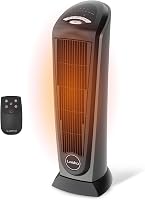
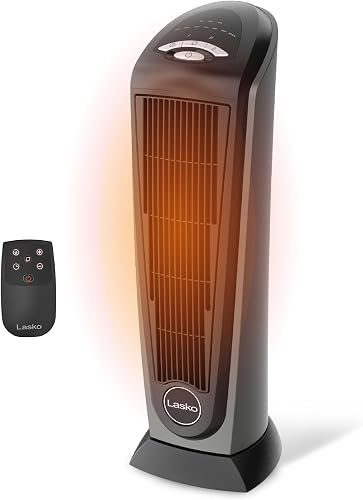
1. Lasko 751320 Ceramic Tower for large-room seating zones
Lasko 751320 Ceramic Tower
- 1500 watts
- Wide oscillation
- 2 heat settings
- 7-hour timer
A practical choice for warming a seating area within a larger room, with remote control and a carry handle. Lasko describes it for medium-sized rooms, so choose it for zone heating.
Pros
- Remote controls heat, oscillation and timer
- Programmable thermostat
- Built-in carry handle
Cons
- Better suited to a defined zone than a large open plan
- Only 2 heat settings
Choose the Lasko if you spend most of your time in one part of a large room and want adjustments within reach of the couch. Its remote handles heat, oscillation and the timer, so you can change airflow as people move around.
The programmable thermostat is useful once that seating area feels comfortable. Use a moderate target and let the heater cycle, rather than keeping it on high after the room has warmed.
Its carry handle also suits a household that moves supplemental heat between occupied rooms. Let the heater cool before moving it, and find a safe outlet location in each room first.
Skip it if your goal is to heat a sprawling open plan from one corner. Lasko describes this model for medium-sized rooms, making a defined zone the sensible job for this top-scoring pick.
2. DREO 1500W Thermostat Heater
DREO 1500W Thermostat Heater
- 1500 watts
- 70-degree oscillation
- DREO claims 34 dB operation
- ECO mode
ECO control suits an occupied office where you want the heater to adjust its output as the room warms. DREO states coverage up to 270 sq ft.
Pros
- ECO mode adjusts between 1000 and 1500 watts
- 70-degree oscillation
- Tip-over and overheat protection
Cons
- Coverage claim stops at 270 sq ft
- Fan sound may still matter in a quiet office
Choose this DREO for an occupied home office where you want the heater to respond as the room warms. Its ECO mode switches between 1000 and 1500 watts, reducing the need to change heat settings by hand.
DREO states coverage up to 270 sq ft, a useful starting point for an enclosed office or living area. Keep the air intake and outlet clear of desk panels, chair backs and storage baskets.
The thermostat senses conditions near the heater, so a warm reading beside the unit may not match the temperature at your desk. Adjust the set point gradually based on comfort where you sit.
Skip it if fan sound distracts you during quiet work. DREO claims 34 dB operation, but that figure alone cannot tell you how noticeable its sound will be in your room.
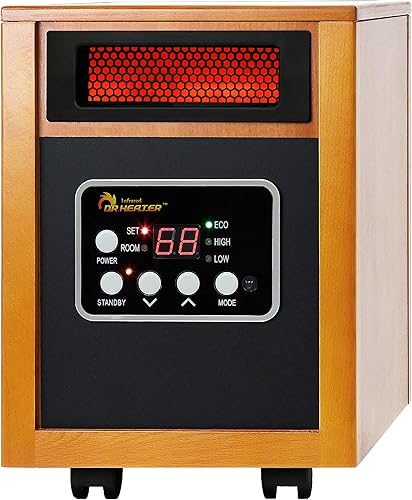
3. Dr Infrared DR-968 Heater
Dr Infrared DR-968 Heater
- Infrared quartz and PTC heating
- 1500 watts
- Caster wheels
- Reusable filter
A cabinet option for an enclosed living room with space for a larger heater. Dr Infrared states coverage of 576 sq ft, the broadest claim here, while caster wheels help with moves on the same floor.
Pros
- Dual heating system
- Caster wheels
- Remote and automatic shutoff timer
Cons
- 19 lb weight makes carrying less convenient
- Cabinet needs more floor depth than the towers
Choose the DR-968 if you prefer a cabinet heater and have a clear floor location in an enclosed living room. Its infrared quartz and PTC system gives you a different heating design from the ceramic towers.
Dr Infrared states coverage of 576 sq ft, the broadest claim here. Use that to shortlist it, then judge suitability by the room's insulation, ceiling height and connection to other spaces.
The cabinet measures 13 in deep, 11 in wide and 16 in tall, and weighs 19 lb. Caster wheels help with moves on the same floor, but this is a less convenient choice for carrying upstairs.
Its reusable filter adds a care task worth planning for. Skip it if you need a lightweight heater to carry often or if furniture leaves only a shallow floor space beside the outlet.
4. DREO 25 Inch Space Heater
DREO 25 Inch Space Heater
- Three heat levels and ECO
- 70-degree oscillation
- DREO claims noise as low as 25 dB
- Child lock
A taller tower for a shared room where fan sound and temperature adjustments matter. DREO states coverage of 100–270 sq ft and includes a child lock.
Pros
- Three heat levels plus ECO mode
- Temperature adjustment in 1°F steps
- Fan mode
Cons
- 25 in tower needs an unobstructed floor location
- Lowest claimed noise may not reflect every setting
Choose this DREO for a shared room where several heat settings and a low noise claim matter more than compact height. DREO claims sound as low as 25 dB and coverage of 100–270 sq ft.
The three heat levels let you reduce output manually, while ECO mode handles adjustments automatically. That choice is useful when one person prefers a steady setting and another wants temperature-based control.
Its thermostat adjusts from 41°F to 95°F in 1°F steps. Small adjustments make it easier to find a comfortable setting without swinging between a chilly room and an overly warm seating area.
The child lock helps prevent control changes, but it does not keep a child away from the heater. Skip this model if you cannot provide a clear floor position outside play areas and walking routes.
5. DREO 16 Inch Large Room Heater
DREO 16 Inch Large Room Heater
- Compact tower
- 70-degree wide-angle heating
- Digital thermostat
- 12-hour timer
A compact choice for a smaller occupied zone within a large room. DREO gives conflicting coverage figures, so plan around the lower 107.6–215.3 sq ft range.
Pros
- 15.83 in height
- Thermostat adjusts in 1°F steps
- Tip-over and overheat protection
Cons
- Conflicting coverage figures
- Compact size does not reduce required safety clearances
Choose this compact DREO when a smaller heater body suits your layout and you only need to improve a defined occupied zone. Its footprint is 6.38 by 6.1 in, although the required clear space extends beyond that base.
DREO gives conflicting room guidance: 107.6–215.3 sq ft and up to 250 sq ft. Plan around the lower range rather than stretching the larger figure to justify a purchase.
A digital thermostat, remote and ECO mode suit someone who wants temperature control without a tall tower. Place it on the floor as directed, rather than raising it onto a desk to bring the airflow closer.
Skip it for a large, cold room that needs substantial whole-room heating. Its compact shape is a placement benefit, not evidence that it can overcome the heat loss of a much bigger space.
6. DREO 30 Inch Oscillating Heater
DREO 30 Inch Oscillating Heater
- Adjustable oscillation angle
- Five heat levels and ECO
- Three fan levels
- Child lock
Adjustable oscillation suits a broad seating area or a room where you want to narrow the airflow sweep. DREO states coverage up to 300 sq ft.
Pros
- Four oscillation angles
- Five heat levels
- Child lock and tip-over protection
Cons
- Nearly 30 in tall
- Wide airflow sweep needs a clear path
Choose this DREO when people sit across a wide area and you want control over how far the airflow sweeps. Its 30, 60, 90 and 120-degree options let you narrow the sweep for one chair or broaden it for shared seating.
DREO states coverage up to 300 sq ft. This makes it a candidate for an enclosed family room, provided the outlet position allows warm air to move toward the occupied area.
Five heat levels offer more manual adjustment than a basic high-and-low heater. Use a lower level once comfortable, or let ECO mode respond to room conditions.
Skip it if sofas or cabinets would block much of the sweep. Its nearly 30 in height also calls for a deliberate floor location, rather than a narrow gap where people brush past it.
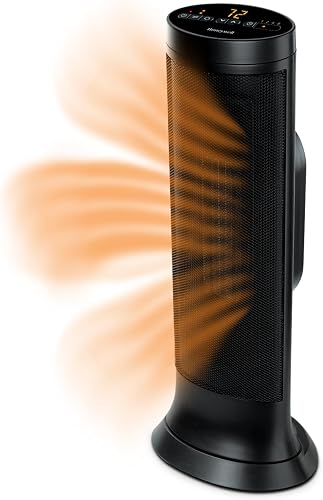
7. Honeywell Slim Ceramic Tower
Honeywell Slim Ceramic Tower
- 750-watt low setting
- Oscillation
- Programmable thermostat
- Four timer choices
The low heat setting suits rooms that need a gentle boost after central heating has done most of the work. Honeywell's room-size descriptions vary, so choose it for supplemental warmth rather than a specific coverage promise.
Pros
- Lower-power heat option
- 360-degree tip-over switch
- Two forms of overheat protection
Cons
- No numeric room coverage figure
- Room-size guidance is inconsistent
Choose the Honeywell if central heating already keeps the room close to comfortable and you want a smaller heat boost. Its 750-watt low setting gives you a clear alternative to full-power operation.
Digital controls and a programmable thermostat cover the main adjustments without a long menu of heat levels. The timer offers 1, 2, 4 or 8-hour shutoff choices for planned periods of supervised use.
Honeywell describes the housing as cool-touch and includes a 360-degree tip-over switch plus two forms of overheat protection. Keep the heater away from children and pets even with those features.
Skip it if you need a numeric coverage figure to narrow your search. Honeywell's small, medium and large-room descriptions vary, so its lower heat setting is a stronger reason to choose it than room-size wording.
8. Pelonis 30 Inch Tower Heater
Pelonis 30 Inch Tower Heater
- 75-degree oscillation
- 12-hour timer
- ECO mode
- Remote control
A tall tower for an occupied room where remote adjustments and a shutoff timer are useful. Pelonis claims coverage up to 280 sq ft but also describes it for small to medium rooms.
Pros
- 75-degree oscillation
- Temperature adjustment in 1°F steps
- Tip-over and overheat protection
Cons
- Room-size guidance varies
- Noise claim gives less guidance for sound-sensitive buyers
Choose the Pelonis for an occupied daytime room where you want a tall tower, remote adjustments and a scheduled shutoff. Its 75-degree oscillation suits a seating area with an open airflow path.
High, low, ECO and fan modes cover manual heat, automatic adjustment and unheated air circulation. The 12-hour timer is useful as a backup shutoff during a planned session, while you remain nearby.
Pelonis claims coverage up to 280 sq ft but also describes the heater for small to medium rooms. Keep it on the shortlist for supplemental warmth rather than relying on the larger number for a cold open plan.
Skip it if very low fan sound is your main requirement. Pelonis claims operation below 55 dB, which gives less useful guidance for that priority than a description of sound at each operating level.
How to choose a space heater for a large room
Choose by room heat loss and layout first, then compare controls and physical size. Floor area helps narrow the options, but it cannot capture drafts, tall ceilings or heat escaping into connected rooms.
Measure the space the heater must serve
Multiply length by width to find square footage. A 15 by 18 ft room is 270 sq ft, but an open doorway into another living area gives warm air more space to spread.
Decide whether you need whole-room supplemental heat or comfort around a couch or desk. A smaller occupied zone can be a reasonable target even when the full room exceeds a heater's stated coverage.
Our room size guide for space heaters explains how to connect area with heating needs. For an uninsulated work area, see our space heaters for garages guide because drafts and use patterns change the decision.
Check ceilings, windows and doors
A tall room contains more air than a low room with the same floor area. Large windows, gaps around doors and cold exterior walls can also increase the heat needed to maintain comfort.
Address simple drafts before expecting a portable heater to compensate for them. Close doors to unused adjoining rooms when appropriate, while keeping exits clear and preserving any ventilation your home needs.
Match controls to your routine
Choose a thermostat if you want the heater to respond as the room warms. Choose more manual heat levels if you prefer to set a steady output and adjust it yourself.
A remote matters when the safe heater location is across the room. A timer matters when you want a planned shutoff, but neither feature makes unattended operation appropriate.
Do oscillating heaters work better in large rooms?
Oscillation helps share airflow between seating positions, while a fixed direction can suit one occupied zone. It changes where the warm air goes without increasing the heater's total output.
Use a wider sweep for a couch and nearby chairs. Narrow it when the outer part of the sweep would point into an empty doorway or toward furniture that blocks the airflow.
Room shape matters as much as sweep angle. One tower cannot send warm air around a wall or heat an adjoining alcove as directly as the open space in front of it.
Infrared designs add a radiant component to the heating approach, and the DR-968 also uses a blower. Our ceramic versus infrared heater comparison explains which approach better fits directed comfort and room heating.
Will a 1500-watt space heater heat a large room?
A 1500-watt heater can provide useful supplemental warmth, but it may not replace the main heat source in a large or drafty room. All eight picks have that maximum power rating despite their different coverage claims.
Electric resistance heaters with the same power draw turn roughly the same electrical energy into heat. Fan design and placement affect how quickly that warmth reaches you, while insulation determines how quickly the room loses it.
A taller tower therefore does not automatically deliver more heat. Buy the shape and airflow that fit your room, rather than assuming height or a larger coverage claim means a higher heating capacity.
Our guide to space heater wattage explains power use, and our space heater running costs guide covers the cost side.
What ECO mode can change
ECO mode can reduce energy use by lowering output or limiting heating as the room approaches the target temperature. It cannot make a cold, drafty room need less heat to stay at the same temperature.
For a rough energy calculation, a heater drawing 1500 watts continuously for 2 hours uses 3 kWh. Multiply that by your electricity rate; thermostat cycling and lower settings change the actual total.
Zone heating can make sense if it lets you lower central heat while keeping occupied rooms comfortable. Our article on space heaters versus central heat explains the wider tradeoff.
How should you set up a heater in a large room?
Set the heater on a stable, level floor near a suitable wall outlet, with the clearances required by its manual. Choose the safe power connection first, then aim the airflow toward the occupied area.
Find the outlet before choosing the corner
Plug the heater directly into the wall, without an extension cord or power strip. If the cord cannot reach a safe position, choose another outlet or a different heating arrangement.
Keep the cord out of walkways and never run it under a rug. Our guide to space heaters and extension cords explains why reaching a distant outlet that way is a poor solution.
Leave room for intake and airflow
Keep curtains, blankets, furniture and other combustible items outside the manual's clearance zone. Allow space behind the heater as well as in front so the air intake stays open.
Don't wedge a slim tower between a sofa and a wall simply because its base fits. The heater needs room to operate safely, and blocked airflow can leave the seating area cold despite a high setting.
Adjust the temperature after the room warms
Start with a comfortable target and give the room time to respond. Raising the thermostat to its highest number does not increase output beyond the heater's available heat setting.
If the heater cycles off while your chair still feels cold, check for drafts and blocked airflow. The temperature near the sensor may differ from the temperature across the room.
Which space heater is safest for a large room?
Choose a heater with appropriate protective features, but make placement and supervision part of the decision. The supplied information does not support naming one model the safest.
Tip-over protection and overheat protection address different faults. Child locks prevent control changes, while cool-touch housing describes the exterior; neither makes close contact or unsupervised use safe.
A timer is a backup for ending a heating session, not a reason to leave the heater running when you go out. Turn it off before sleeping, and keep children and pets away during operation.
Read our space heater safety guide for placement and operating advice. Our guide to leaving a space heater on overnight explains why automatic shutoff does not replace turning it off before bed.
How do you care for a large-room space heater?
Unplug the heater and let it cool before cleaning, then follow the manual's instructions for vents, filters and the housing. Dust buildup can restrict airflow, so inspect the intake regularly during frequent use.
Remove surface dust with the method approved for your model. Avoid spraying cleaner into openings or letting water reach the controls, plug or heating components.
For the DR-968, include its reusable filter in the care routine. Clean and refit it as directed rather than assuming a long-life filter needs no attention.
Check the cord and plug before use and stop using a heater with damage, discoloration or an unusual smell. If the plug or outlet becomes unusually hot, switch off, unplug when safe and have the problem checked before using that outlet again.
Common mistakes that leave a large room cold
The biggest mistake is asking one portable heater to cover too much connected space. Define the occupied zone before changing settings or buying a taller model.
- Choosing by the largest coverage number alone. Compare room conditions and layout, since manufacturers' area claims do not describe identical homes.
- Hiding the heater behind furniture. A clear path to the seating area helps warm air reach people rather than the back of a sofa.
- Running full heat after reaching comfort. Use the thermostat or a lower setting to avoid overheating the nearby zone.
- Treating fan mode as cooling. It moves air but does not lower room temperature like an air conditioner.
- Adding another heater to a circuit without checking the load. High-draw appliances can overload a shared circuit; do not keep resetting a breaker that trips.
If a safely placed heater runs continuously and the room remains cold, reconsider the job. Reducing drafts, improving the main heating arrangement or concentrating on a smaller zone is more useful than increasing the thermostat target.
Which best space heater for a large room should you choose?
Pick the Lasko 751320 Ceramic Tower for couch-side zone heating, especially if easy remote adjustments matter most. Pick the Dr Infrared DR-968 Heater for an enclosed living room where its cabinet size and floor-level mobility fit your routine.
Choose the DREO 1500W Thermostat Heater for an occupied office, or the DREO 30 Inch Oscillating Heater when a wide seating layout makes adjustable airflow worthwhile. The compact DREO fits smaller zones, while the Honeywell suits rooms needing a gentler heat boost.
Before ordering the best space heater for your large room, confirm 3 things: the area it must serve, a safe outlet location and a clear airflow path. If those checks point toward a different design, use our best space heaters for home guide to compare the alternatives.
Our top 3 picks at a glance
-
1
-
2
-
3
Frequently asked questions
What size space heater do I need for a large room?
Measure the room's length and width, then multiply them to find its floor area. Compare that with manufacturer coverage guidance, while allowing for high ceilings, drafts and connected spaces.
A heater that suits a closed room may only warm a seating zone in an open plan.
Can one space heater warm an open-plan room?
One portable heater is usually better treated as supplemental zone heat in an open plan. Air can move into adjoining spaces, making the full area harder to warm.
Choose the occupied area you want to improve, and keep a suitable background heating source for the rest of the space.
Are 1500-watt heaters enough for large rooms?
A 1500-watt heater can add useful warmth to a large room, especially when it supplements existing heat. It may struggle as the only heat source in a drafty room or one with high ceilings.
Room heat loss matters more than a large-room label or a taller cabinet.
Does oscillation help heat a large room?
Oscillation spreads the warm airflow across more of the room, which helps when people sit in different places. It does not increase the heater's heat output.
A fixed direction can work better for one occupied zone, while a wider sweep suits a shared seating area with clear airflow paths.
What safety features should a large-room heater have?
Look for tip-over and overheat protection, then check the manual's placement and power instructions. A child lock or timer cannot replace supervision.
Plug directly into a suitable wall outlet, keep combustible items clear and switch off before sleeping.
Our space heater safety guide covers the key precautions.