6 Best Quiet Space Heaters (October 2026)
The best quiet space heaters include the DREO Quiet Space Heater for desk-side warmth, the DREO Oil Filled Radiator for quiet reading rooms, and the DREO Whole Room Heater for shared seating areas.
On this page (10 sections)
- Which quiet space heater fits your room?
- Quiet space heaters for different needs
- Is a fanless heater always the quieter choice?
- How much room can a quiet heater warm?
- Which controls make quiet heating easier?
- How should you compare wattage and running cost?
- Where should you place a quiet space heater safely?
- How do you care for a quiet heater?
- Which mistakes make a quiet heater disappointing?
- Which quiet space heater should you choose?
The DREO Quiet Space Heater is the best quiet space heater here for directed warmth while you work or read. Choose the DREO Oil Filled Radiator instead if avoiding fan noise is your first priority.
The main choice is between a warm breeze and slower, fanless room heating. A low sound figure helps narrow the fan models, but the kind of sound you tolerate matters just as much.
For room-specific advice, see our guide to space heaters for bedrooms. To compare heating styles across the home, start with the best space heaters for home.
Our picks at a glance
-
1

-
2

-
3

Which quiet space heater fits your room?
Choose a directed fan heater for one seat, a circular fan heater for shared seating, or a fanless radiator for longer periods in one room. Then check whether the controls and safe placement space match your routine.
We compared heating methods, controls, dimensions and safety features, with extra weight on avoiding unwanted sound. The scores reflect those differences rather than a measured noise ranking.
DREO's sound figures describe its own claims under conditions that may differ between models. Use them as context, not proof that one heater will sound a set amount quieter beside your chair.
| Product | Best for | Heating method | Heat output | Controls | Our score |
|---|---|---|---|---|---|
| DREO Quiet Space Heater | desk-side warmth | PTC forced air | 1500W | Remote, thermostat, 12-hour timer | 8.7 |
| DREO Oil Filled Radiator | quiet reading rooms | Radiant oil-filled radiator | 600W, 900W or 1500W | Remote, eco mode, 24-hour timer | 8.1 |
| DREO Whole Room Heater | shared seating areas | PTC forced air | 1500W | Remote, thermostat, 1–12 hour timer | 7.5 |
| DREO Quiet Radiator Heater | simple daily controls | Radiant oil-filled radiator | 600W, 900W or 1500W | Dual knobs | 7.4 |
| Dumos Oil Radiator | room-to-room moves | Radiant oil-filled radiator | 600W, 900W or 1500W | Adjustable thermostat | 7.1 |
| Sweetcrispy Oil Radiator | small studies | Radiant oil-filled radiator | 600W, 900W or 1500W | Adjustable thermostat | 7.0 |
Quiet space heaters for different needs
The top fan pick suits focused warmth, while the highest-ranked radiator suits buyers who want no moving air. The remaining choices offer distinct control styles and room arrangements.
DREO Quiet Space Heater for directed warmth
DREO Quiet Space Heater
- DREO claims noise as low as 34 dB
- 1500W PTC heating
- 41–95°F thermostat
- 70-degree oscillation
Choose this compact fan heater to direct warmth toward your seat or sweep it across a seating area. The remote makes adjustments easier while you work or read.
Pros
- Directional airflow with oscillation
- Thermostat adjusts in 1°F steps
- Remote control included
Cons
- Fan airflow may bother sensitive listeners
- Less suited to buyers who dislike a warm breeze
Choose this DREO for a home office or bedroom seating area where you want heat aimed toward you. Its brushless DC motor and winglet fan design support DREO's claim of operation as low as 34 dB.
The useful distinction is airflow control: keep the outlet facing one seat, or use the sweep to share warmth across nearby seating. A remote lets you adjust the heater without getting up during a call or reading session.
Its base measures 6.77 by 6.77 inches, so the body takes up little space. You still need the full clearance around it, and a small footprint is not permission to tuck it under a crowded desk.
DREO gives a 200 sq ft room reference. Choose it for directed comfort within a suitable room rather than expecting a narrow stream of air to warm several connected spaces.
Skip it if fan sound or a warm breeze distracts you, even at a low level. A radiator is the better match for that preference.
DREO Oil Filled Radiator for quiet reading rooms
DREO Oil Filled Radiator
- Fanless oil-filled heat
- 600W, 900W and 1500W modes
- Eco mode
- Remote and 24-hour timer
A fanless radiator for longer reading or work sessions, with remote control and automatic temperature management. Mute and screen-off modes help reduce distractions.
Pros
- No fan-driven airflow
- Remote and eco mode
- Mute, screen-off and child-lock modes
Cons
- Weighs 17.6 lb
- Needs more floor space than a compact fan heater
Choose this radiator when you spend an evening reading or a workday in one room and want fanless heat with remote adjustments. Its controls make it the most useful radiator here for buyers who often change settings from their seat.
The mute and screen-off modes deserve attention if beeps or a bright display bother you. These address distractions that a low fan-noise figure would not cover.
Eco mode manages heating output around the chosen temperature, while separate power modes let you limit output yourself. Use automatic temperature control for maintaining comfort rather than repeatedly turning the heater on and off.
DREO gives a 250 sq ft coverage reference, but a drafty room may still need help from the home's main heating system. Allow time for an oil-filled heater to warm its internal oil and metal body.
Skip it for short bursts of personal warmth or frequent trips up stairs. Its wheels help on one floor, but the radiator remains a substantial item to lift.
DREO Whole Room Heater for shared seating
DREO Whole Room Heater
- DREO claims 25 dB operation
- 360-degree air outlet
- 1500W PTC ceramic heat
- 41–95°F thermostat
The circular outlet suits rooms with people sitting on different sides of the heater. Choose it where you have open floor space for air to move around the unit.
Pros
- Sends warm air in all directions
- Remote and adjustable thermostat
- Three heat settings plus eco mode
Cons
- Uses a fan
- Needs an open position away from walls and objects
Choose the DREO Whole Room Heater when people sit on different sides of an open area. Its 360-degree outlet makes more sense in that layout than a heater aimed at a single chair.
DREO claims 25 dB operation and recommends rooms of 160–270 sq ft. That sound claim does not establish a direct noise advantage over the first pick, since matching measurement conditions are not provided.
The placement requirement is central to the decision. DREO advises an open position 3 ft from walls and other objects so the heater can sense room temperature more accurately.
Measure that space before ordering, especially in a furnished bedroom. A circular outlet offers little benefit if a cabinet or sofa blocks much of the airflow.
The built-in ambient light is another feature to consider if you prefer a dark room. Skip this model if the only available position is a tight corner, or if you want warmth aimed mainly at your feet.
DREO Quiet Radiator Heater for simple controls
DREO Quiet Radiator Heater

- Fanless oil-filled design
- 600W, 900W and 1500W modes
- Adjustable thermostat
- Tip-over shutoff
Choose this fanless radiator if you prefer turning separate heat and temperature knobs. It fits buyers who want simple local controls rather than remote adjustments.
Pros
- No fan noise
- Separate heat and thermostat knobs
- DREO identifies it as ETL certified
Cons
- Adjustments require reaching the heater
- Weighs 17.9 lb
Choose this DREO radiator if you prefer 2 physical knobs to menus and remote adjustments. One sets the heat mode, while the other sets the thermostat.
That separation suits a steady routine: select an output for the day's weather, then adjust the temperature for comfort. A simple knob does not provide the same kind of exact numerical target as a digital temperature control.
Its 7 M-shaped fins provide the heated surface, and the fanless design avoids blowing air across your seat. It makes sense for a study or living area where you stay long enough for the room to warm.
DREO gives this model the same 250 sq ft room reference as its digital radiator. The stronger reason to choose between them is how you want to control the heat.
Skip it if bending or reaching for adjustments is awkward. For remote control and eco mode, compare the DREO Oil Filled Radiator.
Dumos Oil Radiator for moving between rooms
Dumos Oil Radiator
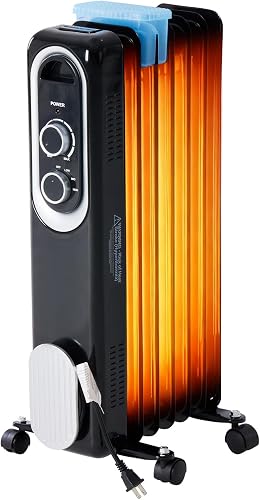
- Fanless radiant heating
- 600W, 900W and 1500W modes
- Four casters and carry handle
- Tip-over and overheat protection
A fanless option for moving between a small office and another room on the same floor. Four casters help with rolling, while the carry handle helps with careful repositioning.
Pros
- Fanless design
- Four casters and carry handle
- Three heat modes
Cons
- Still weighs 13 lb when lifting
- Requires a dedicated grounded wall outlet
Choose the Dumos when your heating routine moves between small rooms on the same floor. Its 4 casters and carry handle help you reposition a fanless heater without carrying it for the whole journey.
Dumos recommends rooms of 10–15 m², or about 108–161 sq ft. That is a sensible target for an enclosed office or reading room, rather than an open living and dining area.
Plan an outlet position in each room before treating it as a movable solution. Dumos requires a dedicated grounded wall outlet, so a convenient parking spot is useful only if the cord reaches an appropriate receptacle.
Let the heater cool and unplug it before moving it. Wheels help on clear floors, but thresholds, stairs and thick rugs can still make relocation awkward.
Skip it if daily use involves carrying it upstairs, or if you want remote adjustments. Its strongest fit is a simple same-floor routine, not constant moving between every cold spot in the home.
Sweetcrispy Oil Radiator for small studies
Sweetcrispy Oil Radiator
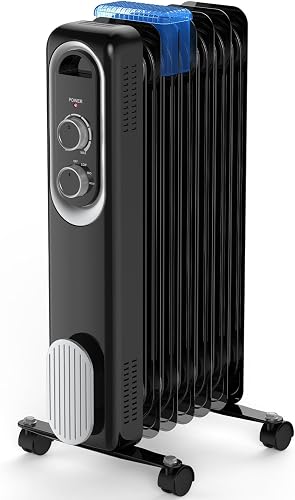
- Fanless radiant heating
- 600W, 900W and 1500W modes
- Four casters and carry handle
- Tip-over and overheat protection
A fanless radiator for a small study or office where you spend longer stretches seated. Sweetcrispy recommends rooms up to 161 sq ft.
Pros
- No fan-driven breeze
- Three heat modes
- Four casters and carry handle
Cons
- Best kept to smaller enclosed rooms
- Must plug directly into a grounded wall receptacle
Choose the Sweetcrispy for a small enclosed study where you want fanless warmth during longer seated sessions. Sweetcrispy recommends rooms up to 161 sq ft, which gives it a clear role as a small-room option.
It measures 22.8 inches tall and weighs 13 lb. Check where it will stand in use and where you can store it after it has cooled, rather than judging fit by the narrow body alone.
The adjustable thermostat and 3 output choices cover basic heat management. Its wheels and handle also help if you need to move it out of the way between uses.
The Sweetcrispy and Dumos share many core features, so there is little reason to expect a large difference in heating style. Choose between them based on the controls and placement requirements that fit your room.
Skip it for a large open room or fast personal heat. Sweetcrispy requires a direct connection to a grounded wall receptacle, without an extension cord or power strip.
Is a fanless heater always the quieter choice?
A fanless radiator removes continuous airflow noise, which makes it the better starting point if a fan distracts you. It can still produce occasional clicks or metal expansion sounds as it heats and cools.
Think about which sound bothers you most. A steady low fan sound may blend into an office with other background noise, while brief thermostat clicks may stand out in a very quiet reading room.
Air movement also affects comfort apart from sound. If you dislike warm air blowing at your face or legs, choose a radiator even if a fan model has an appealing decibel claim.
Fan heaters are better suited to quick, directed warmth because they move heated air toward you. Oil-filled radiators take time to warm their internal mass and continue releasing stored warmth after the element switches off.
That stored heat does not mean free energy or greater heat output from the same electricity. It changes how warmth arrives and fades.
For a fuller comparison of response time and comfort, read oil-filled heaters versus ceramic heaters.
How much room can a quiet heater warm?
Choose around the room's heat loss and layout, not its floor area alone. A closed room with ordinary ceilings is easier to warm than an equally sized space open to a hallway or staircase.
Measure length and width, then consider drafts, window area and ceiling height. Coverage figures are starting points, so avoid buying right at a model's stated limit for a cold, poorly insulated room.
Every heater here has a maximum output of 1500W. A different outlet shape or radiator body can change heat distribution, but it does not turn that input into enough heat for an entire cold house.
Keep the intended use clear. Taking the chill off one seat is a smaller job than raising the temperature throughout a large room.
Close doors to unused spaces where practical, and keep vents and exits clear. If a suitable heater runs constantly without making the room comfortable, address drafts or use the main heating system rather than adding portable heaters around the circuit.
Our guide to how to choose a space heater explains how room size, heating type and output work together.
Which controls make quiet heating easier?
Prioritize a usable thermostat and reachable controls over a long feature list. The right controls reduce repeated adjustments and help the heater maintain a comfortable room.
A digital temperature target suits buyers who want a visible number. A dial suits those who prefer simple adjustments and can accept finding their preferred position by feel.
The heater senses temperature near its own body, which may differ from the temperature beside your chair. Avoid trapping it near furniture or placing it in a draft that makes its sensor unrepresentative of the room.
A remote helps if you have limited mobility or want to adjust heat during seated work. Check that the heater itself remains accessible for switching off and unplugging.
Mute and screen-off functions can matter as much as fan noise in a dim, quiet room. The digital DREO radiator offers both, making it worth considering if sound and light distractions come together.
Treat a timer as a convenience for supervised use. Set a reminder or shutoff interval while you are awake, rather than using the timer to justify leaving a portable heater running unattended.
How should you compare wattage and running cost?
Compare power multiplied by active heating time, not noise level or heater type. A quiet motor and a fanless body do not, by themselves, establish lower electricity use.
At full output, a 1500W heater uses 1.5 kilowatt-hours during an hour when its heating element stays on continuously. Multiply that energy use by your electricity rate to estimate the cost.
The radiator choices offer 600W, 900W and 1500W settings. Lower output can suit milder weather, but it may also take longer to warm a cold room.
A thermostat can reduce active heating time once the room reaches the target. It cannot promise a fixed saving because drafts, starting temperature and the temperature you choose all affect operation.
Avoid turning the thermostat far above your desired room temperature to hurry warm-up. When the heater is already running at its selected maximum output, a higher target mainly tells it to keep heating longer.
See how many watts a space heater uses and our space heater running cost guide for help estimating use.
Where should you place a quiet space heater safely?
Use a stable, level position with clear space around it, following the manual's placement rules. Keep portable heaters at least 3 ft from bedding, curtains, furniture and other items that can burn, or farther if required.
Measure from nearby objects, including anything that could move into the space. A curtain that hangs clear now may blow toward the heater when a door opens.
Plug directly into an appropriate wall outlet, with the cord visible and clear of foot traffic. Do not run the cord under rugs, pinch it behind furniture or stretch it across a doorway.
Avoid extension cords, power strips and multi-plug adapters. Our guide to space heaters and extension cords explains why outlet location should be part of your buying decision.
Keep hot surfaces out of reach of children and pets. A child lock prevents certain control changes; it does not make the body cool to touch or stop a child from placing something against it.
Turn the heater off before sleeping or leaving the room unattended. Read our space heater safety guidance and overnight heater guide for more on safe routines.
How do you care for a quiet heater?
Keep air openings and radiator fins clear of dust, using the cleaning method in the manual. Switch off, unplug and let the heater cool fully before cleaning or moving it.
For a fan heater, dust around the intake and outlet can restrict airflow. Clean accessible surfaces gently, and do not push tools through a grille or open the housing.
For an oil-filled radiator, remove dust from accessible gaps without bending fins or getting controls wet. These are sealed heaters, so routine care does not involve adding or changing oil.
Inspect the cord and plug before use, especially after storage. Stop using the heater if you find damage, an oil leak, repeated breaker trips or an outlet that feels loose or becomes hot.
Store the heater dry, with its cord arranged without tight bends. Before the next cold season, check that its base or casters remain secure and that stored items have not damaged the controls.
Which mistakes make a quiet heater disappointing?
The biggest mistake is choosing by a sound number before deciding how you want heat delivered. A low-noise fan heater can still be the wrong choice if you dislike airflow.
Buying a radiator for a brief 10-minute desk session is another mismatch. It spends part of that short visit warming its own oil and metal, while a fan model better suits an immediate warm breeze.
Do not try to quiet a heater by covering it, blocking an intake or pushing it into furniture. Leave its safety features intact and solve poor placement by moving the heater to a suitable position.
Avoid expecting one portable heater to compensate for open doors, strong drafts and several connected rooms. Reduce the heating area where practical before assuming another model will solve the problem.
Finally, separate ordinary operating sounds from a new fault. Scraping, repeated rattling or a sudden change in sound calls for switching off and checking the manual, rather than simply tolerating it.
Which quiet space heater should you choose?
Choose your quiet space heater by heating style first, then by room layout and controls. That order prevents a low noise claim from outweighing the way you actually use the room.
- Choose the DREO Quiet Space Heater for directed warmth at one seat, with the option to share airflow across nearby seating.
- Choose the DREO Oil Filled Radiator for fanless reading or work sessions with remote adjustments and fewer display distractions.
- Choose the DREO Whole Room Heater for shared seating when you can provide the open placement its circular outlet needs.
- Choose the DREO Quiet Radiator Heater if you prefer separate physical knobs and easy-to-understand local adjustments.
- Choose the Dumos Oil Radiator for a small-room routine that involves rolling the heater between suitable outlets on one floor.
- Choose the Sweetcrispy Oil Radiator for longer sessions in a small enclosed study with basic heat controls.
Before ordering, mark the safe placement area and check the route to the wall outlet. If bedroom fit is your next decision, compare the room arrangements in our guide to the best space heaters for bedrooms.
Our top 3 picks at a glance
-
1
-
2
-
3
Frequently asked questions
Are oil-filled heaters quieter than fan heaters?
Fanless oil-filled heaters avoid the airflow noise that fan heaters produce. They can still make occasional thermostat clicks or sounds as metal warms and cools, so fanless does not mean completely silent.
Choose a radiator if a steady fan sound bothers you more than brief operating sounds.
What is a quiet space heater for a bedroom?
A quiet space heater for a bedroom should match your sound tolerance and fit safely away from bedding. Choose a fanless radiator if airflow bothers you, or a low-noise fan heater for directed warmth.
Use it to warm the room while you're awake, then switch it off before sleeping.
Can I leave a quiet space heater on overnight?
Turn a portable space heater off before you go to sleep, even if it runs quietly or has a timer. Automatic shutoffs do not replace supervision or safe placement.
Use it while you're awake and nearby, and read our space heater overnight guide for more.
Does a quieter space heater use less electricity?
A quieter heater does not automatically use less electricity. Power draw, time spent heating and your electricity rate determine running cost, while the thermostat affects how long the heating element stays active.
Our guide to space heater running costs explains how to estimate use for your room and schedule.