How to Choose a Space Heater: Type, Watts, Room Size
To decide how to choose a space heater, match the heat type to your routine, check room size and wattage, then confirm safe placement. Choose quiet radiant warmth for longer seated use or a ceramic fan heater for warm airflow.
On this page (9 sections)
- How to choose a space heater for your room and routine
- What type of space heater should you choose?
- How many watts should your space heater use?
- What room size can a space heater handle?
- Which controls and comfort features are worth choosing?
- What safety checks should you make before buying?
- How should you set up and care for a space heater?
- Which buying mistakes should you avoid?
- How do you choose the right space heater?
To work out how to choose a space heater, match its heat type to your daily routine, check the room's heating needs, and confirm a safe place beside a wall outlet. Controls and portability come after those checks.
Choose a ceramic fan heater for warm airflow during short visits to a room. Consider an oil-filled radiator for quiet warmth during longer seated use, or an infrared cabinet if its mix of radiant heat and airflow suits your space.
Our space heater safety and buying guide covers the wider checks before you buy. Here, start with the room and work toward a specific heater.
How to choose a space heater for your room and routine
Decide where you'll use the heater and how long you'll stay there before comparing models. A cold desk used for an hour calls for a different approach from a reading room occupied all afternoon.
Write down the room's dimensions, your usual seating position, and the available wall outlets. Check for curtains, upholstered furniture, bedding, and foot traffic around each possible heater location.
A heater's base may fit in a corner while its required clearances do not. If no suitable location leaves enough space around it, choose another room or another heating approach.
How should you choose a space heater for short or long use?
For short sessions, warm airflow can deliver comfort where you're sitting without waiting for every surface in the room to warm. A ceramic fan heater is a sensible starting point for a home office used between other tasks.
For longer seated use, an oil-filled radiator can suit readers who dislike a steady fan sound. Its heated body takes time to warm and cool, so allow for that slower response.
If you move between rooms often, consider the route as well as the heater's handle or wheels. Stairs, thresholds, and storage space can matter more than a remote or display.
What type of space heater should you choose?
Choose the heating method by how you want warmth to reach you. Ceramic fan heaters move heated air, oil-filled radiators warm the room through their heated bodies, and infrared heaters deliver radiant heat, sometimes with a blower.
| Type | How it warms | Best fit | Main tradeoff |
|---|---|---|---|
| Ceramic tower | A fan moves air across a heated ceramic element | Short sessions and moving warm air across seating | Fan sound and airflow may bother some readers |
| Oil-filled radiator | Heated oil transfers heat through the radiator body | Longer, quiet sessions in an enclosed room | Slower response and a body that stays hot after shutoff |
| Infrared cabinet | Radiant heating, sometimes combined with fan-driven heat | Buyers who want the model's particular heat delivery and cabinet shape | Some models still have a blower and need substantial floor space |
An oil-filled radiator's sealed oil carries heat inside the heater; it isn't fuel that you refill. Let the unit cool before moving or storing it, since switching it off doesn't cool its body right away.
Infrared is not a promise of silent operation. Check whether the model includes a blower, especially if you're choosing it for a quiet workspace.
For a closer look at the main tradeoff, read our oil-filled heater versus ceramic heater comparison. Choose by response time and noise preference rather than assuming one type always uses less electricity.
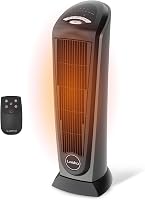
Lasko 751320: choose it for shared seating and simple remote control
The Lasko 751320 Ceramic Tower suits a living room or office where you want warm airflow across more than one seat. Its oscillation lets you spread that airflow instead of aiming it at one fixed position.
It has 2 heat settings, an electronic thermostat, a remote, and a 7-hour timer. At 8.3 inches deep, 7.25 inches wide, and 22.5 inches high, it needs a floor location with clear space around the tower.
Skip it if avoiding fan sound is your first priority. A radiator is a better type to consider for that need, while the Lasko fits buyers who want moving air and straightforward controls.
Lasko identifies it as ETL-certified and includes overheat protection and cool-touch housing. Keep children and pets clear of the heater even with those features.
DREO Oil Filled Radiator: choose it for quiet, longer sessions
The DREO Oil Filled Radiator suits a reading area or home office where you stay for a while and prefer warmth without fan-driven airflow. Its remote lets you adjust it from your chair.
It offers 600-, 900-, and 1,500-watt modes plus eco mode. Wheels and handles help with room-to-room moves once it has cooled, though its 17.6-pound weight matters if the route includes stairs.
Skip it for brief visits when you want an immediate stream of warm air. Also measure its 12.83-inch-deep, 9.92-inch-wide, 26.14-inch-high body before choosing a storage spot.
DREO includes a child lock, mute and screen-off modes, and a 24-hour timer. These controls suit an occupied room where light and button sounds are distractions; the child lock doesn't make the hot body safe to touch.
Dr Infrared DR-968: choose it if a cabinet fits your space
The Dr Infrared DR-968 Heater suits buyers who want a low cabinet shape and a combination of infrared quartz, PTC heating, and a blower. It isn't a fan-free alternative to a radiator.
Its cabinet measures 13 inches deep by 11 inches wide by 16 inches high. Caster wheels help with movement on a suitable floor, but the 19-pound body is less convenient to carry between levels.
The electronic thermostat spans 50–85°F, and the heater includes a remote and a 12-hour automatic shutoff timer. Its 6-foot cord helps you judge outlet reach before choosing a location.
Skip it if you need a narrow tower or want to avoid blower sound. Don't choose it solely for its larger coverage claim; the room's heat loss still matters.
How many watts should your space heater use?
Choose enough output for the room, then use a lower setting when it maintains comfort. All 4 heaters here have a maximum input of 1,500 watts, so their shapes don't indicate different maximum electrical power.
Electric resistance heaters turn nearly all the electricity they draw into heat within the room. Differences in airflow, radiant warmth, placement, and controls affect where that heat goes and how comfortable you feel.
A thermostat reduces running time when the room reaches its target. Eco mode may change output or cycling, but it doesn't remove the need to match the heater to the room.
DREO 1500W Thermostat Heater: choose it for compact, adjustable airflow
The DREO 1500W Thermostat Heater suits buyers who want a small floor tower with temperature control and oscillation. Its body measures 5.9 inches deep by 5.89 inches wide by 15.79 inches high.
It has 1,000- and 1,500-watt operating levels, plus eco mode that adjusts operation using a temperature sensor. The 70-degree oscillation helps direct warm airflow across a seating area.
DREO includes a remote, a 12-hour timer, overheat protection, and tip-over protection, and identifies the heater as ETL-certified. Its automatic power-off after 24 hours without interaction is a backup feature, not a reason to leave it unattended.
Skip it if your main goal is fan-free warmth or a selectable setting below 1,000 watts. The oil-filled DREO offers lower fixed power options.
Does a lower setting always save electricity?
A lower setting uses less electricity per minute, but total use depends on running time. A heater drawing 1,000 watts for 90 minutes uses the same energy as one drawing 1,500 watts for 60 minutes.
Set a comfortable temperature rather than selecting the highest number by habit. Raising the thermostat far above your target generally makes the heater run longer, rather than increasing its maximum output.
Read how many watts a space heater uses to compare power settings. To estimate use across a day or month, see how much it costs to run a space heater.
What room size can a space heater handle?
Measure the room, then adjust your expectations for drafts, ceiling height, and open doorways. Coverage figures help narrow the search, but they don't account for every home's heat loss.
Multiply length by width to find floor area. A room measuring 12 by 15 feet has 180 sq ft, but a high ceiling or an open stairway adds heating demand beyond that number.
DREO gives coverage guidance of 250 sq ft for its oil-filled radiator and 270 sq ft for its thermostat tower. Lasko describes the 751320 for medium-sized rooms, while Dr Infrared gives 576 sq ft for the DR-968.
Those claims don't make the DR-968 a higher-output heater than the others here. With the same maximum electrical input, a much larger coverage number needs careful attention to room conditions.
An enclosed room with normal ceiling height is easier to warm than a connected living and dining area. Close an interior door when appropriate, while keeping exits clear and maintaining any ventilation your home needs.
Use what size space heater you need for a room for a sizing walkthrough. If a room stays cold with the heater running continuously, address drafts or the main heating system instead of assuming another similar-wattage model will solve it.
Which controls and comfort features are worth choosing?
Prioritize a thermostat, usable controls, and a noise level you can live with. Add oscillation, a remote, or display controls when they solve a specific problem in your room.
A thermostat is useful when you want steady comfort without frequent manual adjustments. Our space heaters with thermostats guide explains the choices for readers who put temperature control first.
The temperature near a heater may differ from the temperature at your chair. Start with a moderate target and adjust gradually rather than expecting the displayed number to describe every part of the room.
Choose oscillation when several seats need airflow, but consider a fixed direction when only one work area needs warmth. Neither arrangement should send heat toward curtains, bedding, or other items that can burn.
For noise, distinguish steady fan sound from button beeps and display light. A mute setting addresses control sounds; it doesn't remove the sound of a fan.
A timer is most useful as a planned shutoff while you're still awake and present. Don't schedule a heater to start in an empty room simply because its controls allow it.
What safety checks should you make before buying?
Buy only if you can meet the heater's clearance, outlet, and supervision requirements. Safety features are backups for problems, not permission to squeeze a heater into an unsuitable spot.
Check for recognized safety certification and read the model's instructions before deciding where it will go. Confirm allowed floor surfaces, required clearance on every side, and any restrictions on room use.
Keep the heater at least 3 feet from items that can burn, or farther if its manual requires it. Allow for curtains moving, bedding slipping, and a chair being pushed back during normal use.
Plug portable electric heaters directly into a suitable wall outlet. Don't use an extension cord or power strip, and don't run the cord under a rug or through a doorway.
These heaters draw substantial current at full power. If a breaker trips, stop using the heater on that circuit and have the cause checked rather than repeatedly resetting it.
Children and pets need a clear boundary around the unit. A cool-touch housing, child lock, or tip-over switch doesn't prevent every burn or accident.
Turn portable heaters off before sleeping or leaving the room. The [U.S.
Fire Administration's heating safety guidance](https://www.usfa.fema.gov/prevention/home-fires/prevent-fires/heating/) covers separation from combustible items, direct wall connections, and supervision.
Read our space heater safety advice for the full placement checks. Our guide to using a space heater with an extension cord explains why a longer cord is the wrong fix for poor outlet access.
How should you set up and care for a space heater?
Set it on an approved, stable surface, keep airflow paths clear, and inspect it before use. Follow the manual for assembly, cleaning, and any filter care.
Before the first use, remove packaging and fit any supplied feet or wheels as directed. Inspect the cord, plug, and body for damage, then position the unit with all required clearances.
Keep the cord visible and free of tension. If it won't reach the outlet without stretching across a walkway, choose another approved location.
Start with a moderate thermostat target and check comfort from your normal seat. If the room feels uneven, reconsider placement within the manual's limits before raising the temperature.
Switch off, unplug, and let the heater cool before cleaning. Remove dust from accessible grilles and surfaces as directed, without spraying cleaner into the unit or opening the housing.
The DR-968 includes a filter, so include its care in your routine according to the manual. Don't assume a filter labeled for long-term use can be ignored.
Stop using any heater with a damaged cord, loose-fitting plug, unusual smell, or signs of overheating. Store a cooled heater in a dry place with its cord loosely arranged rather than tightly wrapped around the body.
Which buying mistakes should you avoid?
Avoid choosing by coverage claims or extra features before checking room fit. These mistakes can leave you with a heater that is awkward to place or poorly matched to your routine.
- Buying a tiny base for a crowded corner: Required clearance takes more space than the heater itself.
- Choosing infrared to eliminate fan sound: Some infrared models, including the DR-968, use a blower.
- Expecting a radiator to act like a fan heater: Its slower warm-up suits longer sessions better than brief visits.
- Assuming eco mode guarantees savings: Room temperature, heat loss, and running time still determine energy use.
- Turning the thermostat to maximum: Use your actual comfort target instead of keeping the heater running after the room is warm enough.
- Using a heater to dry clothing: Fabric must stay clear of the body, grille, and heat path.
- Buying for unattended warmth: A timer or automatic shutoff doesn't make sleeping or leaving with it running a sound plan.
How do you choose the right space heater?
The final rule for how to choose a space heater is to match the heating method to your routine, then reject any model you cannot place safely. Among suitable models, choose the controls and portability you'll actually use.
Pick the DREO Oil Filled Radiator for longer, quiet sessions and lower fixed power options. Choose the Lasko 751320 Ceramic Tower for oscillating airflow with a remote and straightforward heat controls.
Choose the Dr Infrared DR-968 Heater if you prefer a low cabinet and accept its blower and carrying weight. Pick the DREO 1500W Thermostat Heater for a compact tower with eco control and wide oscillation.
Before ordering, mark out the heater's footprint and required clearances beside the intended outlet. Then use our best space heaters for home guide to compare options that fit that usable space.
Frequently asked questions
How many watts should a space heater have?
Choose wattage for the heat your room needs and the electrical requirements you can meet. Many portable heaters have a 1,500-watt high setting, with lower modes for lighter demand.
A lower setting draws less power while running, but longer running time can offset that reduction.
What type of space heater is best for a bedroom?
An oil-filled radiator suits quiet bedroom use while you're awake; a ceramic fan heater suits readers who want moving warm air. Choose by noise, available floor space, and controls, then turn it off before sleeping.
Compare suitable options in our space heaters for bedrooms guide.
Can a space heater heat a large room?
A space heater can supplement heat in a large room, but output and heat loss set its limits. Open doorways, high ceilings, and drafts increase demand, so a coverage figure cannot settle the choice alone.
Our large-room space heater guide explains the room conditions worth checking.
Are space heaters safe to leave on overnight?
Turn portable space heaters off before sleeping or leaving the room. A thermostat, timer, or automatic shutoff does not replace supervision, and bedding must stay clear throughout use.
Read our guide on leaving a space heater on overnight before planning how to warm a bedroom.