Vornado Heater vs Lasko: Which Is Better? (October 2026)
For Vornado heater vs Lasko, choose the Lasko 751320 Ceramic Tower for couch-side control and oscillation. Pick the Vornado AVH10 Heater for automatic heat and airflow adjustments, or the Vornado MVH Heater for manual heat-level choices.
On this page (11 sections)
- Vornado heater vs Lasko: what is the main difference?
- Who should buy the Lasko 751320?
- Who should buy the Vornado AVH10?
- Who should buy the Vornado MVH?
- Which heater fits your room layout?
- How should you set up and adjust the heater?
- Which safety differences should affect your choice?
- Which heater uses less electricity?
- How do you care for these heaters?
- Which common buying mistakes should you avoid?
- Vornado heater vs Lasko: which should you choose?
For Vornado heater vs Lasko, choose the Lasko 751320 Ceramic Tower for remote control and oscillation, the Vornado AVH10 for automatic heat and airflow adjustments, or the Vornado MVH for manual heat-level choices.
The better buy depends on how you use the room. A heater beside an occupied couch serves a different routine from one warming a home office while you work.
NeatUpgrade compared the controls, dimensions and safety features of these 3 models. Start with the adjustment you want to make least often, then check that your room has a safe place for the heater.

Vornado heater vs Lasko: what is the main difference?
The Lasko directs warmth with an oscillating tower, while the Vornados use Vortex Heat Circulation to move warm air around a room. Their controls give you the clearest reason to choose one over another.
Oscillation changes the direction of outgoing airflow. That suits a seating area where you want warmth directed across more than one position, provided furniture doesn't block the path.
Vornado describes its circulation system as gently distributing heat throughout small to medium rooms. Choose that approach when your goal is room comfort rather than following a sweeping stream of warm air.
Neither approach removes the need for a suitable room. A drafty doorway, open stairwell or poorly insulated wall can carry heat away faster than a portable heater can make the space comfortable.
Vornado heater vs Lasko: which controls fit your routine?
Choose Lasko for adjustments from your seat, AVH10 for automatic changes during use, or MVH for a knob-based routine. These differences matter more than buying by brand name alone.
A remote helps when you regularly change settings. Automatic climate control helps when you prefer setting a target and letting the heater respond while you stay in the room.
The MVH takes a more direct approach: choose a heat mode, then adjust the thermostat to suit your comfort. Its numbered settings require some initial adjustment rather than selecting a displayed room temperature.
Who should buy the Lasko 751320?
Buy the Lasko for an occupied living room or bedroom where remote adjustments and directed airflow will get regular use. Skip it if your priority is automatic airflow adjustment rather than control from across the room.
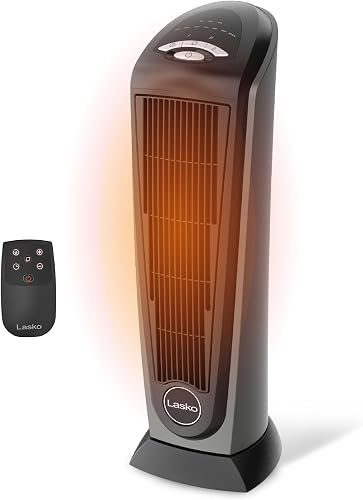
Its remote handles heat settings, oscillation and the 7-hour timer. You can stop the sweep when you want a steady airflow direction or change the operating period without walking over to the tower.
The programmable thermostat also means you don't have to run heat continuously at one setting. Use it to maintain comfort rather than repeatedly switching the heater off when the room becomes too warm.
This is a practical match for a seated evening routine or a home office where you often want small changes. The built-in carry handle also helps when moving the heater between rooms after it has cooled.
Choose another option if the only available spot is behind a chair, next to curtains or in a busy walkway. A narrow tower still needs clear space, and its moving airflow needs somewhere to go.
For more models with similar shapes and controls, see our ceramic tower heaters guide.
Who should buy the Vornado AVH10?
Buy the AVH10 for an occupied room where you want fewer manual adjustments. Its Auto Climate control changes power and airflow to maintain your preferred temperature.
That makes it a useful fit for a home office where you want to focus on work. Set a comfortable target, allow the room to warm, and adjust only if your seating area still feels too cool or warm.
The digital display and adjustable thermostat suit someone who prefers a temperature-based control over a numbered dial. Its 2 heat settings provide another way to tailor operation.
A fan-only mode adds a separate use when the room doesn't need heat. It circulates air without heating, though it doesn't cool a room the way an air conditioner does.
Skip the AVH10 if selecting among several fixed heat levels matters more than automatic adjustment. The MVH gives you an extra heat mode, while the Lasko is the clearer choice when remote operation leads your wish list.
Don't choose the AVH10 on a promise of lower bills alone. Automatic power adjustment is a control feature, and the savings depend on how much heat your room needs and how long you use it.
Who should buy the Vornado MVH?
Buy the MVH if you prefer physical controls and heat-level choices. Skip it if you want a digital temperature readout or the AVH10's automatic airflow adjustment.
The MVH offers low, medium and high heat modes alongside a thermostat with 7 settings. The thermostat cycles the heater on and off, so manual controls don't mean you must keep switching it yourself.
Start with a heat mode suited to the chill, then adjust the thermostat after the room has had time to respond. Treat its numbers as reference points for comfort, not exact room temperatures.
This suits someone who uses the same room regularly and is happy to find a preferred dial position. If another person changes the controls, noting your usual setting makes it easier to return to it.
The extra heat mode is useful when you want more choice in output. It doesn't establish that the MVH can warm a larger room than the other models.
Both Vornados are built for U.S. voltage requirements and supported for U.S. use. Vornado offers replacement support for up to 5 years; check the applicable terms before relying on that support outside its intended market.
Which heater fits your room layout?
The Lasko has the smallest footprint, while the Vornados fit a lower profile. Measure the usable placement area, including clearances, rather than comparing height alone.
These dimensions are depth, width and height:
- Lasko: 8.3 x 7.25 x 22.5 in; 2.5 lb.
- AVH10: 11.63 x 9.25 x 12 in; 5.4 lb.
- MVH: 9.2 x 10.4 x 10.6 in; 4.1 lb.
A shorter heater isn't permission to slide it beneath furniture or into a shelf. Follow the exact manual's placement rules, and leave the intake and outlet fully open.
Think about where people walk, where doors swing and where pets settle. A location that works in an empty room may become unsafe once someone pulls out a chair or drops a blanket.
For a bedroom, choose a position that stays clear of bedding even when covers hang over the edge. Our bedroom space heater guide covers other features that matter in that setting.
Room area is only part of the fit. If the space has high ceilings, several open doorways or strong drafts, use our space heater sizing guide before assuming any of these models will meet the need.
How should you set up and adjust the heater?
Start with a stable, clear location and a suitable wall outlet, then adjust the heat after the room has had time to warm. Placement comes before thermostat settings.
Read the manual before first use, including its required clearances and permitted surfaces. Keep combustible items at least 3 feet away, or farther wherever the manual requires it.
Plug the heater directly into a suitable wall outlet. Avoid power strips and extension cords; our guide to space heaters and extension cords explains why the connection matters.
Route the cord where it won't be pinched by furniture, trapped under a rug or crossed by foot traffic. Don't stretch it tightly to make an otherwise unsuitable location work.
Once the heater is running, assess comfort from your usual seat. The air near the appliance can feel different from the air across the room, so avoid judging the setting only while standing beside it.
Give each adjustment time to take effect. Repeatedly raising the thermostat can leave the room warmer than intended once its surfaces and air have caught up.
Use the Lasko's timer as a limit on an attended session. It doesn't make the heater suitable for running after you leave the room or fall asleep.
Which safety differences should affect your choice?
The Vornados include explicit tip-over protection, while the Lasko combines overheat protection with a self-regulating ceramic element. All 3 have cool-touch exteriors or housing.
Lasko identifies the 751320 as ETL certified. Certification and protective switches are useful safeguards, but they don't remove the need for clear space or careful operation.
If tip-over protection is on your must-have list, either Vornado meets that requirement here. Don't infer that feature from the Lasko's tower shape, overheat protection or cool-touch housing.
Cool-touch housing also doesn't make a heater a toy or a safe resting place for fabric. Keep children and pets away from the outlet grille, cord and controls.
Switch the heater off before moving it, unplug it and let it cool. Stop using it if the plug or outlet becomes unusually hot, the cord is damaged, or you notice a burning smell.
Don't repeatedly restart a heater that shuts down unexpectedly. Let it cool and follow the manual's troubleshooting steps; our space heater safety guide covers the wider operating routine.
Which heater uses less electricity?
There is no supported electricity-use winner among these models. Lasko specifies 1500 watts, but comparable wattage figures aren't available here for both Vornados.
Running cost depends on electrical draw, time spent heating and your local electricity rate. A thermostat can reduce unnecessary runtime once the room is comfortable, but it can't cancel the heat lost through drafts.
The AVH10 adjusts power and airflow, and the MVH cycles heat to maintain its thermostat setting. Neither feature establishes a guaranteed saving over the Lasko's thermostat-controlled operation.
Lower heat settings can help match output to a smaller need. If that setting leaves the heater running much longer, though, the total energy used still depends on the full session.
Warm the occupied room rather than trying to cover several connected spaces. Close unused doors where practical, reduce drafts and use our space heater running-cost guide to estimate the bill.
How do you care for these heaters?
Keep air openings clear and inspect the cord regularly. Dust buildup and blocked airflow deserve attention before you reach for a higher heat setting.
Switch off, unplug and let the heater cool before cleaning. Follow the manual's cleaning method, and avoid spraying liquid into vents or controls.
Remove surface dust with the tools and method the manufacturer permits. Don't open the housing or reach inside the heater unless its instructions expressly allow that work.
Check the cord and plug when changing rooms or taking the heater out of storage. Store it dry, protect the cord from sharp bends and avoid piling objects against the housing.
A heater that needs frequent resets or shows damage needs attention, not a workaround. Keep its guide and support information so you can follow the correct next step.
Which common buying mistakes should you avoid?
Avoid buying on height, heat-level count or a room-warming claim alone. Match the controls and safe placement to the way you'll actually use the room.
A taller body doesn't prove stronger heating, and an extra heat mode doesn't prove greater capacity. The Lasko's shape and the MVH's output choices solve different needs.
Don't confuse a thermostat with a timer. A thermostat responds to temperature, while a timer limits the operating period; our space heaters with thermostats guide explains the distinction.
Also avoid buying solely because a heater is described as quiet. Both brands use quiet-operation language, but there are no comparable sound measurements here to rank these models for a noise-sensitive reader.
Finally, don't use a portable heater to compensate for a placement problem. If the only outlet forces the cord across a doorway or the heater close to bedding, choose a different location or heating approach.
Vornado heater vs Lasko: which should you choose?
Choose the Lasko for frequent seat-side adjustments, the AVH10 for automatic room comfort, or the MVH for a repeatable knob-and-heat-mode routine. Let your normal occupied session decide the Vornado heater vs Lasko question.
Before ordering, identify the outlet and measure a safe placement area. If none of these fits that space or routine, our best space heaters guide compares other heater types.
Frequently asked questions
Is a Vornado or Lasko heater better?
Choose Lasko for adjustments from your seat, or Vornado for its room-circulation approach. The Lasko 751320 combines oscillation with a remote and timer, while the AVH10 manages heat and airflow automatically; the MVH suits buyers who prefer selecting a heat mode and using a thermostat knob.
Does the Lasko heater oscillate?
Yes, the Lasko 751320 Ceramic Tower has widespread oscillation, and its remote lets you switch that function on or off. Leave an open path for the moving airflow rather than placing the tower behind furniture; oscillation can't carry warmth freely through a blocked space.
Which Vornado heater has automatic temperature control?
Both Vornado models regulate heat automatically, but they work differently. The AVH10 uses Auto Climate to adjust power and airflow toward your preferred temperature, while the MVH uses a 7-setting thermostat to cycle heat on and off after you select a heat mode.
Can these heaters heat a whole room?
These models are intended for supplemental room heating, with both brands describing use in small or medium spaces. Actual comfort depends on insulation, ceiling height, drafts and layout, so a closed room is a better match than an open area connected to several cold spaces.
What safety features do these heaters have?
Both Vornados include cool-touch exteriors, tip-over protection and automatic shut-off; the Lasko has cool-touch housing and overheat protection. Lasko also identifies its heater as ETL certified, but no safety feature replaces a stable location, clear airflow, a suitable wall outlet or supervision while the heater runs.