Dreo vs Lasko Space Heaters: Which Is Better? (October 2026)
In this Dreo vs Lasko space heater comparison, choose Lasko for straightforward room heating or DREO for automatic heat adjustment. Both offer ceramic heat, a remote and oscillation.
On this page (10 sections)
- Dreo vs Lasko space heater: what actually changes?
- Which heater fits your room and floor space?
- Who should buy Lasko, and who should skip it?
- Who should buy DREO, and who should skip it?
- Which controls help with comfort and electricity use?
- Which heater is quieter for work or bedroom use?
- How should you set up either heater safely?
- How should you use the timers and shutdown features?
- What care and common mistakes should you plan for?
- Dreo vs Lasko: which should you choose?
For Dreo vs Lasko space heater buyers, choose Lasko for straightforward supplemental heat and DREO for automatic heat adjustment in a smaller tower. Both reach 1500W, so DREO's extra controls don't mean greater maximum heating power.
Lasko suits a living room or home office where you want familiar heat settings, a thermostat and a remote. DREO is the stronger fit when you want the heater to adjust its output as the room warms.
Start with your outlet location and available clear floor space. A heater that fits your routine still needs a safe place to run.
Dreo vs Lasko space heater: what actually changes?
The main differences are control options, physical size and shutdown features. Both use ceramic heat, include a remote and oscillate to spread warm air.
Lasko provides 2 heat settings and a programmable thermostat. DREO adds ECO mode, which selects its working power based on the surrounding temperature.
That makes Lasko a sensible choice if you prefer choosing a heat setting yourself. DREO better suits someone who wants fewer manual adjustments during a long, supervised work session.
Neither brand wins simply because its tower is taller or its coverage claim sounds larger. Those details help with placement and expectations, but your room's heat loss still matters.
The best ceramic tower heaters guide compares more options in this style. For other heating methods, start with our guide to the best space heaters.

Which heater fits your room and floor space?
DREO fits a smaller floor footprint, while Lasko needs more room for its taller body. Measure a safe position before choosing either model.
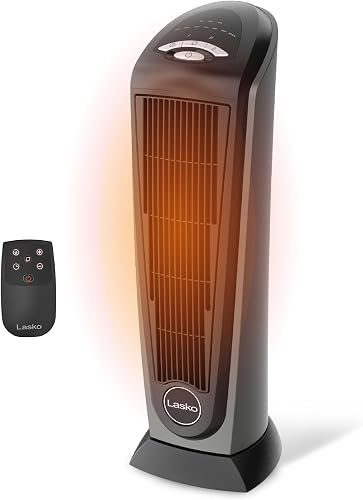
Lasko measures 8.3 in deep, 7.25 in wide and 22.5 in tall. DREO measures 5.9 in deep, 5.89 in wide and 15.79 in tall.
Those measurements describe the heater itself, not the space it needs to operate. Add the clearances required by the manual, including space around the air inlet and outlet.
A narrow gap beside a couch may fit the base but still be unsuitable for heating. Curtains, blankets and furniture must stay clear even when someone moves a chair or opens a door.
DREO has 70° oscillation, while Lasko offers widespread oscillation without a matching angle for comparison. Leave the airflow path clear across the sweep, rather than judging placement with the heater facing forward.
How should you compare Dreo vs Lasko room coverage?
Use room conditions before coverage claims to judge whether either heater makes sense. DREO claims coverage of 270 sq ft, while Lasko describes the 751320 as suitable for medium-sized rooms.
A closed office with an ordinary ceiling is easier to warm than a drafty room connected to a hallway. Open doors, cold windows and high ceilings increase the amount of heat you need.
Because both have the same maximum power, don't choose DREO solely on its coverage figure. A larger number doesn't establish that it will warm a difficult room better than Lasko.
If you need to heat an open living area, our space heaters for large rooms guide can help you assess alternatives. Neither model should be your answer to a room that needs more heat than one portable heater can supply.
Who should buy Lasko, and who should skip it?
Buy Lasko if you want straightforward controls and plan to move the heater between suitable rooms. Its built-in carry handle makes it easier to lift once it is off, unplugged and cool.
The remote controls heat settings, oscillation and the timer. That suits a seated routine, such as reading or working, where you want to make adjustments without reaching down to the tower.
Lasko's temperature settings run from 60°F to 85°F. A programmable thermostat gives you a target to work toward instead of relying only on a continuous heat setting.
It also suits buyers who prefer making a clear choice between heat levels themselves. You don't need an automatic power-selection mode if you are comfortable adjusting the heater as conditions change.
Skip Lasko if limited clear floor space makes the larger base awkward. Its extra height doesn't justify squeezing it between furniture or putting it on a table.
Choose DREO instead if automatic output adjustment is central to your routine. If tip-over protection is a deciding requirement, DREO explicitly includes it; confirm the exact Lasko model's provisions before choosing it for that need.
Who should buy DREO, and who should skip it?
Buy DREO if you want automatic heat adjustment during occupied-room use. Its ECO mode switches between 1000W and 1500W based on ambient temperature.
That is useful when an office starts cold but needs less heat later. You can choose a comfortable target and let the heater adjust its working mode instead of repeatedly changing the power yourself.
DREO's temperature settings run from 41°F to 95°F. The wider range gives you more setting choices, but it doesn't promise that the whole room will reach either end of that range.
Its smaller body also suits rooms where a safe floor position is available but space is tight. Keep it outside foot traffic rather than sliding it under a crowded desk beside papers and bags.
Skip DREO if you expect ECO mode to guarantee a smaller electricity bill. Savings depend on the setting, room conditions and how long the heater draws power.
Also skip it if the coverage claim is your only reason for choosing it for a large, drafty space. For more detail on this model's controls, see our DREO thermostat heater review.
Which controls help with comfort and electricity use?
A moderate thermostat setting and a limited heating session matter more than chasing the highest temperature. Both models provide temperature control, while DREO adds automatic power selection.
A thermostat senses conditions near the heater. The far end of the room can feel cooler, especially near a draft or behind furniture.
Start with a comfortable target and allow the room time to respond before raising it. Turning the thermostat far above your goal doesn't increase either heater's maximum output.
If the heater stops while your chair still feels cold, look at placement and drafts first. Raising the target may overheat the area around the heater without solving uneven comfort.
At continuous full power, either model uses 1.5 kWh in an hour. Actual use changes when controls reduce power or stop the heating element, so compare your expected routine rather than the brand name alone.
Read how much it costs to run a space heater to calculate your own running cost. Our space heaters with thermostats guide also explains how to choose around temperature control.
Which heater is quieter for work or bedroom use?
DREO provides a specific noise claim; Lasko doesn't provide a comparable decibel figure. DREO claims 34 dB operation, while Lasko describes its heat settings as quiet.
That gives noise-sensitive buyers a reason to consider DREO, but it doesn't establish a measured sound difference between these models in the same room. Fan sound can stand out more during reading than during conversation or television.
Room surfaces and placement affect how noticeable sound becomes. A heater positioned where airflow hits nearby furniture may also feel more distracting than one with a clear path.
Don't block vents or drape anything over the heater to soften noise. If fan sound is unacceptable, compare other heater styles instead of trying to muffle either tower.
Our quiet space heater guide covers more options. For warming a bedroom while you're awake, see the bedroom space heater guide.
How should you set up either heater safely?
Place either heater on a stable, level floor and plug it directly into a suitable wall outlet. Choose the location before you unbox it so the cord can reach without crossing a walkway.
Read the manual for assembly, operating steps and clearances. Keep combustible items at least 3 ft away, and follow any greater or more specific distances the manual requires.
Check the cord, plug and housing for damage before use. Don't run the cord under a rug, pinch it behind furniture or connect it through a power strip.
Lasko includes a self-regulating ceramic element, overheat protection and cool-touch housing. DREO includes tip-over and overheat protection, and both brands identify these heaters as ETL-certified.
Those safeguards support careful use; they don't replace it. Cool-touch housing doesn't make the airflow safe to cover, and tip-over protection doesn't make a busy play area a suitable heater location.
Keep children and pets from approaching either heater. Avoid positions where a door, rolling chair or passing foot could knock it over.
During initial use, stay nearby and check that airflow remains clear. Stop using the heater if you notice a burning smell, discoloration, a loose outlet or unusual heat at the plug connection.
Our space heater safety guide covers daily precautions. The guide to choosing a space heater can help you check room fit and electrical needs before ordering.
How should you use the timers and shutdown features?
Use the timer to end a supervised heating session, then switch the heater off whenever you leave. DREO has a 12-hour timer, compared with Lasko's 7-hour timer.
The longer option suits an extended day in an occupied home office. Lasko's timer is enough for many shorter periods of reading, watching television or working.
DREO also powers off after 24 hours without interaction. That is a separate backup feature, not a recommended running schedule.
A timer can't tell whether a blanket has fallen nearby or a pet has blocked the airflow. Set it around your actual plans rather than choosing the longest period by default.
Switch either heater off before going to sleep, even when time remains. Read whether you can leave a space heater on overnight before planning bedroom use.
What care and common mistakes should you plan for?
Keep the vents clear, inspect the cord regularly and clean only after the heater is unplugged and cool. Dust buildup can restrict airflow, so follow the manual's cleaning method.
Clean the outside gently and avoid letting liquid enter the housing. Don't open the case or assume either model has a washable filter.
When moving rooms, turn the heater off and let it cool first. Carry the body securely, then check the new location's outlet, floor and clearances instead of assuming the old setup transfers unchanged.
Before seasonal storage, remove dust and inspect for damage. Store the heater dry and protect the cord from sharp bends or heavy objects.
Avoid these common buying and use mistakes:
- Choosing by tower height alone. A taller body doesn't establish greater heating power.
- Expecting ECO mode to overcome drafts. Reducing heat loss may help more than changing controls.
- Pointing heat at an obstruction. Furniture and stored items can block useful airflow.
- Using an extension cord to reach a better spot. Choose a safe position within reach of a wall outlet.
- Treating a shutdown feature as supervision. Turn the heater off when the room is no longer occupied.
If a circuit breaker trips, don't keep resetting it and restarting the same arrangement. Stop and address the electrical load or have the outlet and circuit checked.
Dreo vs Lasko: which should you choose?
Choose Lasko for straightforward room heating; choose DREO when automatic adjustment is the feature you'll use daily. Make safe placement the first pass-or-fail check for either model.
Lasko is the better match for someone who wants to select a heat level, set a thermostat and make occasional remote adjustments. Its carry handle also helps if you regularly move supplemental heat between rooms.
DREO is the better match for someone who spends long periods in one occupied room and wants power to adjust as conditions change. Choose it for that routine and its smaller footprint, rather than expecting more maximum heat.
Skip both if your only available spot blocks airflow, needs an extension cord or puts the heater within reach of bedding. Solve the placement problem before choosing a model.
Your final Dreo vs Lasko space heater decision should come down to fit, controls and realistic room needs. Use our guide to space heater electricity use to plan how long you'll run your choice.
Frequently asked questions
Is Dreo or Lasko better for a space heater?
Choose Lasko for straightforward room heating with a programmable thermostat and carry handle. Choose DREO if automatic heat adjustment and a smaller footprint matter more.
Both have the same maximum power, so decide by room fit and controls rather than expecting one to produce more heat at full power.
Which heater covers a larger area?
DREO claims coverage of 270 sq ft, while Lasko describes its heater as suitable for medium-sized rooms. Those descriptions don't establish a direct performance ranking.
Both reach 1500W, and insulation, ceiling height, drafts and open doorways affect how much space either heater can keep comfortable.
Do Dreo and Lasko space heaters use the same wattage?
Both heaters reach 1500W at maximum output. DREO's ECO mode selects between 1000W and 1500W based on room temperature, while Lasko provides 2 heat settings and a thermostat.
Total electricity use depends on power draw over time, including how often the controls reduce or stop heating.
Which heater has the longer timer?
DREO has a 12-hour timer, compared with Lasko's 7-hour timer. DREO also switches off after 24 hours without interaction, which is a separate backup feature.
Set a timer for a supervised session, and switch either heater off before leaving the room or going to sleep.
Can I plug a Dreo or Lasko heater into an extension cord?
Plug either heater directly into a suitable wall outlet, without an extension cord or power strip. DREO explicitly requires a direct wall connection.
Follow each manual's electrical instructions, and use our guide to space heater extension cords to plan a safe position before buying.