5 Best Space Heaters for Garages (October 2026)
The best garage space heaters include the Dr Infrared Patio Heater for fixed workstations, the InoKraft 240V Garage Heater for larger workshops, and the Buyplus Garage Heater for occasional projects.
On this page (9 sections)
- How we chose garage space heaters
- Garage heater features at a glance
- The best space heater for garage work: our picks
- What should you check before buying a garage heater?
- How much electricity does a garage heater use?
- How should you set up a garage heater safely?
- How do you care for a heater in a dusty garage?
- Which garage heating mistakes waste the most effort?
- Which best space heater for garage work fits your routine?
The best space heater for garage spot warmth is the Dr Infrared Patio Heater, especially if you work at one bench. Choose the InoKraft 240V Garage Heater when you want broader heating and can arrange its required electrical connection and professional installation.
Start by deciding whether you need a warm work area or a warm garage. That choice matters more than a remote, timer, or large coverage figure.
For broader room heating, compare our space heaters for large rooms. Our guide to choosing a space heater explains how heater type, room conditions, and electrical supply work together.
Our picks at a glance
-
1

-
2

-
3
How we chose garage space heaters
We compared electrical requirements, heat direction, controls, and placement for common garage jobs. The picks cover fixed workstations, larger workshops, and occasional projects where a portable heater makes sense.
The top pick favors useful warmth at a regular work area without requiring a dedicated high-voltage installation. The higher-output InoKraft earns its place for buyers whose goal is heating more of an enclosed garage.
We also considered practical limits: a mounted heater needs a clear installation point, while a floor unit competes with tools, cords, and walking space. Coverage estimates carry less weight than those limits because garages vary so much in insulation and air leakage.
Garage heater features at a glance
The InoKraft provides the most heat output, while the other choices focus on smaller areas or direct warmth. Use the comparison to narrow your electrical and placement options before choosing controls.
| Product | Best for | Heat type | Power | Placement | Our score |
|---|---|---|---|---|---|
| Dr Infrared Patio Heater | fixed workstations | Infrared radiant | 900W, 1200W, or 1500W | Wall or ceiling | 8.0 |
| InoKraft 240V Garage Heater | larger workshops | Fan-forced | 7,500W maximum | Wall or ceiling | 7.2 |
| Buyplus Garage Heater | occasional projects | PTC ceramic | 750W or 1500W | Portable | 7.0 |
| Shinic Ceiling Garage Heater | workbench lighting | Radiant quartz | 750W or 1500W | Ceiling | 6.9 |
| Karveden Patio Garage Heater | changing work areas | Fan-forced | 750W or 1500W | Portable floor unit | 6.6 |
More wattage gives a heater more heating capacity, but it also demands a suitable electrical supply. A lower-output heater can still be the better purchase when you only need warmth where you stand.
The best space heater for garage work: our picks
Choose the Dr Infrared for a fixed work area, the InoKraft for broader heating, or a portable model for changing tasks. The Shinic adds a work light for buyers planning an overhead setup.
Dr Infrared Patio Heater
- Infrared heat
- 900W, 1200W, and 1500W settings
- 120V plug
- Wall and ceiling brackets included
Direct warmth toward a regular work area without giving up floor space. Its remote helps with overhead operation, but it has no thermostat for maintaining a set room temperature.
Pros
- Three heat settings
- Remote control
- Wall and ceiling brackets included
Cons
- No thermostat
- Requires a suitable mounting location
Dr Infrared: best garage space heater for a fixed workstation
The Dr Infrared Patio Heater suits someone who spends most garage time within one clear heating path. Mount it toward a workbench or regular standing area rather than expecting it to warm every corner.
Its infrared element directs warmth toward people and objects, which makes sense when heating all the garage air would be wasteful. You still need a position where stored items, shelving, or the task itself won't block the heat.
The heater has 900W, 1200W, and 1500W settings, a remote, and brackets for wall or ceiling mounting. It uses a standard 120V connection, so the installation plan centers on safe mounting, outlet access, and the required clearances.
The main tradeoff is no thermostat. You choose the output and turn it down or off as conditions change, rather than selecting a room temperature for automatic control.
Buy this for a repeatable work setup where keeping the floor clear matters. Skip it if you walk between several work zones or need a heater to maintain a steady temperature throughout the garage.
Before mounting, map where you actually stand during the job. A position that faces the empty center of the garage may be less useful than one aimed toward your regular working position.
InoKraft 240V Garage Heater
- 7,500W fan-forced heat
- 240V NEMA 14-50P plug
- Digital thermostat and ECO mode
- Professional electrician installation required
Choose this higher-output heater for longer garage sessions and broader air heating. Plan for the specified electrical connection and professional installation before ordering.
Pros
- Digital thermostat
- High, low, and ECO modes
- Adjustable louvers and mounting angle
Cons
- Requires a 240V NEMA 14-50 outlet
- Professional electrician installation required
InoKraft: for longer sessions across a larger workshop
The InoKraft 240V Garage Heater suits buyers who want heated air across a larger enclosed work area. It is the strongest fit here for moving among a bench, tool station, and project table during longer sessions.
Its 7,500W fan-forced output is paired with a digital thermostat adjustable from 40°F to 99°F. High and low modes, ECO mode, and a 1–24 hour timer give it more temperature management than a heater with simple output switches.
InoKraft estimates coverage up to 750 sq ft. A tall, drafty garage can need more heat than a smaller insulated space, so use that figure to screen options rather than size an installation by itself.
The included NEMA 14-50P plug requires a 240V NEMA 14-50 outlet. Standard 120V outlets, NEMA 14-30 dryer outlets, and NEMA 6-50 welder outlets are incompatible, and InoKraft requires professional electrician installation.
Adjustable louvers and 5 installation angles help direct airflow after choosing a suitable mounting point. Plan that point with the electrician so the heater can distribute warmth without blowing straight into nearby storage.
Skip this model if you only want brief warmth at one bench or cannot arrange the electrical work. Its output and controls make more sense when you intend to use a larger portion of the garage regularly.
Buyplus Garage Heater
- 750W and 1500W heat modes
- Fan-only mode
- Carry handle and non-slip base
- Overheat protection
A portable option for short projects in a small work area. Its handle makes relocation practical once it is unplugged and cool, while the non-slip base helps it stay put.
Pros
- Two heat levels
- Fan-only mode
- Carry handle
Cons
- Needs clear floor space
- Confirm supply voltage before buying
Buyplus: for short projects without a permanent mount
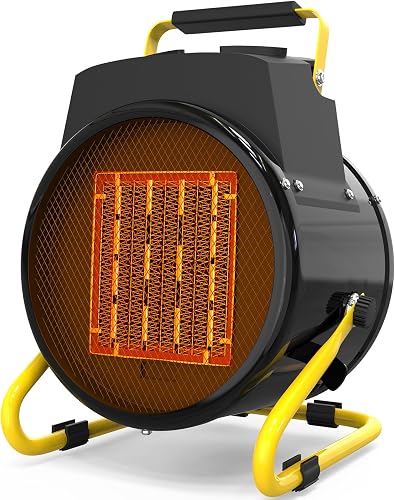
The Buyplus Garage Heater suits occasional work in a small, clear area. It is a practical format when you want to put the heater away after a project instead of installing an overhead unit.
The PTC ceramic heater offers 750W and 1500W heat modes plus fan-only operation. Buyplus estimates coverage up to 200 sq ft, which fits a small-area role better than a plan to heat a large garage from end to end.
Buyplus puts operating noise below 40 dB. That may appeal if your garage work involves quiet assembly or reading instructions, although the sound you notice will also depend on distance and the room.
A carry handle and non-slip base help with placement, but portability only helps if each new position is safe. Unplug it and let it cool before moving it, then keep the cord away from wheels, tools, and walking routes.
The supplied information does not establish its supply voltage, so confirm that requirement before buying. Also check that a suitable outlet is close enough for direct connection.
Choose this model when a permanent mount would get in the way of changing projects. Skip it if your only available floor space is a busy aisle or if you expect one portable unit to keep a large, uninsulated garage comfortable.
Shinic Ceiling Garage Heater

- Radiant quartz tubes
- 750W and 1500W heat settings
- Remote control
- Built-in halogen work light
Combines directed warmth with a work light above a regular task area. The adjustable angle helps aim the heat, but people moving beyond its path will need a different heating plan.
Pros
- Built-in work light
- Adjustable heating angle
- Remote control
Cons
- Focused heating area
- Remote batteries are not included
Shinic: for an overhead workbench with added light
The Shinic Ceiling Garage Heater suits a regular workbench that needs directed warmth and extra visibility. Its built-in halogen work light gives it a distinct role among these picks.
Dual quartz tubes warm people and objects in front of the heater. The head adjusts through up to 90°, letting you aim the heat toward the working position rather than simply pointing it straight down.
It has 750W and 1500W settings, with 5 modes covering heat-and-light combinations. A remote controls the overhead unit, although batteries are not included.
The heater uses a 120V, 3-prong grounded plug. Check the mounting location against both the outlet position and the garage door's full path before deciding where it belongs.
Choose it if you work in the same spot and would use the added light. The light can supplement your work area, but fine cutting, measurement, or inspection may still call for separate task lighting.
Skip this model if you mainly need warm air throughout the room. Also skip an overhead installation if moving doors, tall storage, or the required clearances leave no suitable position above the work area.
Karveden Patio Garage Heater

- 750W and 1500W heat modes
- Fan-only mode
- Carry handle
- Overheat protection
Fits buyers who want to reposition a compact heater between suitable work areas. Its 120V connection suits that role, provided each location has a suitable outlet and clear floor space.
Pros
- Compact body
- Carry handle
- Non-slip bracket pads
Cons
- Limited output for a large garage
- Floor placement needs protection from traffic
Karveden: for moving between suitable work areas
The Karveden Patio Garage Heater fits buyers who want a compact floor unit they can reposition between tasks. Its carry handle and bracket with non-slip pads support that simple use.
The 120V heater provides fan-only operation and 750W or 1500W heating. Karveden estimates coverage up to 200 sq ft, so choose it for a nearby work area rather than broad heating in a cold, open garage.
A useful setup might place it near an assembly station for one session, then near another clear work area after it has been unplugged and cooled. Each position still needs direct outlet access and enough clearance for the heater and its cord.
The unit includes overheat protection. That helps address internal overheating, but it does not make a crowded floor, blocked airflow, or a damaged outlet acceptable.
Choose Karveden when a compact body and a known 120V connection match your plans. Buyplus is another portable option, while the mounted models make more sense when the heater will stay in one place.
Skip Karveden if hoses, power leads, or rolling equipment already fill the floor. A small heater can still create a large placement problem when safe working space is limited.
What should you check before buying a garage heater?
Check power access, the area you need warm, and a safe placement location before comparing convenience features. Those checks can rule out a heater before its controls or coverage estimate matter.
Does the space heater match your garage outlet?
Confirm the voltage, plug shape, circuit capacity, and condition of the receptacle. A socket that accepts a plug is only part of the electrical check.
Other equipment may share that circuit, including lights, a freezer, chargers, or power tools. A heater running alongside a large tool can overload a circuit that handled either appliance alone.
Have an electrician assess uncertain wiring or repeated breaker trips. Do not solve an incompatible connection with a plug adapter, and do not keep resetting a breaker without finding the cause.
Do you need whole-room warmth or direct heat?
Choose radiant heat when you spend most of your time in one position. Choose broader air heating when your work regularly takes you around an enclosed garage.
Radiant heat works best with a clear path to the person or surface you want warm. A bench front, vehicle, or storage rack can block that path even when the heater is pointed toward the right part of the room.
Air heating depends more on retaining warm air inside the space. Our ceramic vs infrared heater comparison explains how these approaches differ for everyday use.
How much of the garage are you heating?
Measure the occupied area, then consider ceiling height, insulation, door gaps, and winter conditions. A floor-area figure alone misses how much cold air enters and how quickly heat escapes.
A small heater can be useful near a bench while the far side of the garage stays cold. That is a reasonable result if personal warmth is your goal, but it will disappoint if you expect every tool and surface to reach room temperature.
For whole-garage heating in severe cold, get a heat-loss assessment before committing to equipment. It can help establish whether electrical upgrades, insulation work, or a different heating plan should come first.
Will the heater fit around the door and storage?
Check the garage door fully open, fully closed, and moving between those positions. Include its tracks, opener, and any shelves or hanging storage near the proposed heater location.
A mounted unit frees floor space only if its heat path and clearances stay open. Allow for future storage changes rather than choosing a spot that works only while the garage is empty.
For portable units, mark out a stable location outside vehicle paths and normal foot traffic. If you cannot keep that space clear during a project, choose another installation approach.
Which controls will you actually use?
A thermostat is useful for longer sessions because it can cycle the heater around a set temperature. Output switches suit shorter tasks where you can adjust heat as needed.
A remote helps when a heater is overhead, while a timer can limit a session's duration. Neither feature replaces checking the garage before use or switching the heater off when you leave.
For a wider look at formats beyond these garage picks, see our best space heaters for home guide.
How much electricity does a garage heater use?
A heater drawing 1500W continuously uses 1.5 kWh in an hour, while a 7,500W heater uses 7.5 kWh over the same period. Multiply kilowatts by hours of operation, then by your electricity rate to estimate the energy charge.
Those figures assume continuous operation at full output. Lower settings and thermostat cycling change consumption, while a cold, leaky garage can keep a heater running for much longer.
InoKraft's ECO mode adjusts output in response to room and set temperatures. It cannot offset an open garage door or guarantee a particular reduction in electricity use.
Compare heating plans by the comfort you need and the hours you will use them. A brief period of focused warmth may use less energy than trying to raise the temperature of the entire garage.
For the calculation steps, see how much it costs to run a space heater and our guide to space heater running costs.
How should you set up a garage heater safely?
Set up the heater according to its manual, with direct outlet access and the required clearances. Switch it off when you leave, and keep it away from gasoline, flammable vapors, and combustible dust.
Prepare the area before switching it on
Move cardboard, shop towels, packaging, and other combustible items away from the heater's required clearance zone. Look above and behind the unit as well as in front of it.
Check for damp floors, leaks, and cords that could be pinched by a door or crushed by a vehicle. Outdoor-use wording does not remove the need to follow the model's exact instructions for exposure and electrical protection.
Do not run a heater during work that creates flammable vapors or clouds of combustible dust. Heating a garage does not make spraying finishes, handling fuel, or collecting sawdust around a heat source safe.
Connect and position it correctly
Plug the heater directly into a suitable wall outlet. Avoid extension cords and power strips, and do not stretch the cord across a walkway to reach a preferred spot.
Mounted heaters need secure attachment to a structure that can support them, using the specified hardware and orientation. Keep their required distance from ceilings, walls, doors, vehicles, and stored objects.
Portable heaters belong on a stable, level surface that meets the manual's instructions. A non-slip base helps resist sliding, but it does not prevent someone from kicking or striking the unit.
Watch for problems during use
Stop using the heater if the plug or outlet becomes hot, you notice scorching or a burning smell, or a breaker trips. Have the cause checked before using that connection again.
Overheat protection is a backup feature, not permission to cover the heater or block airflow. Repeated shutoffs call for checking placement and following the manual's fault instructions.
Our space heater safety guide covers everyday precautions. Read whether a space heater can use an extension cord before planning a setup around a distant outlet.
How do you care for a heater in a dusty garage?
Keep vents, accessible guards, and the surrounding area free of dust, following the manual's cleaning method. Unplug the heater and let it cool completely before cleaning or moving it.
Garage dust can collect faster than household dust, especially near sanding or cutting work. Check the heater regularly rather than waiting until airflow looks restricted or debris is visible inside.
Avoid touching heating elements or pushing tools through guards. Do not spray cleaners into the housing or take the unit apart beyond what the manual permits.
Inspect the cord, plug, and mounting hardware before seasonal use. Store a portable heater clean and dry, with its cord protected from sharp tools and heavy objects.
Which garage heating mistakes waste the most effort?
The biggest mistake is buying for the whole garage when you only need one warm work area, or buying a spot heater while expecting whole-room comfort. Define the job before choosing the heater.
Another common error is treating rapid element warm-up as rapid room heating. A heater can begin producing warmth quickly while the garage air, slab, tools, and walls remain cold.
Trying to heat through an open door also works against you. Seal avoidable drafts where appropriate, but keep any ventilation required for the work you are doing.
Do not use an electric heater to warm a garage while idling a vehicle inside. Heating does not address exhaust hazards, and an open garage door does not make indoor engine operation safe.
Finally, avoid setting a higher thermostat temperature to make a heater warm the room faster. On a simple on-off thermostat, that usually extends operation rather than increasing the heater's available output.
Which best space heater for garage work fits your routine?
The best space heater for garage use matches your work pattern and available installation. Pick the model after you can point to its safe operating location and confirm its electrical connection.
- Choose Dr Infrared for a fixed workstation where directed heat and a clear floor matter.
- Choose InoKraft for longer sessions across a larger enclosed garage, with its required circuit and professional installation.
- Choose Buyplus for occasional small-area projects, after confirming its supply voltage.
- Choose Shinic for an overhead workbench setup where the added light would be useful.
- Choose Karveden for compact portable heat between suitable locations with direct 120V outlet access.
Before ordering, measure the installation area and check the outlet rather than relying on the garage's floor area alone. If your next heating need is indoors, our best space heaters for bedrooms guide covers options for that different setting.
Our top 3 picks at a glance
-
1
-
2
-
3
Frequently asked questions
What type of heater works best in a garage?
Radiant heat suits a fixed workbench, while a higher-output fan-forced heater suits people who move around an enclosed garage. Choose by the area you need warm, then confirm electrical access and mounting clearances.
Insulation and drafts matter more than a broad coverage claim when you want whole-room warmth.
Can I use a regular 120V space heater in a garage?
Yes, if its manual permits the garage's conditions and you have a suitable electrical circuit. Keep the heater clear of vehicles, stored items, moisture, and combustible materials.
Plug it directly into a suitable wall outlet, and do not operate it where gasoline vapors, flammable solvents, or combustible dust are present.
What size heater do I need for a garage?
Size the heater around floor area, ceiling height, insulation, outdoor temperature, and your desired indoor temperature. A small heater may suit one work area without warming the whole building.
For a starting point, use our space heater size guide, then account for garage doors, drafts, and the manufacturer's installation limits.
Is a 240V garage heater worth considering?
Yes, when you need broader heating for longer work sessions and can provide the required electrical installation. The InoKraft needs a 240V circuit, a NEMA 14-50 outlet, and professional electrician installation.
It cannot connect to standard household outlets, NEMA 14-30 dryer outlets, or NEMA 6-50 welder outlets.
Where should a garage space heater go?
Place it where the manual permits, with clear space around the heater and an unobstructed heat path. Check the garage door's full travel, nearby shelves, parked vehicles, and normal walking routes.
A mounted unit can free floor space; our space heater safety guide explains the placement precautions to review before setup.