Ceramic vs Infrared Heater: Which Should You Buy? (October 2026)
For a ceramic vs infrared heater choice, pick ceramic for oscillating warm air or an infrared cabinet when its controls and shape suit your room. The infrared models here also move air, and neither type automatically costs less to run.
On this page (11 sections)
- Ceramic vs infrared heater: how does each warm a room?
- Which model should you buy for your daily routine?
- How should room size change your choice?
- Which heater gives you useful control over comfort?
- Does a ceramic or infrared heater cost less to run?
- Which heater is easier to fit beside furniture?
- Which type suits quiet work or bedroom use?
- How should you set up either heater safely?
- What care keeps airflow clear?
- Which common buying mistakes should you avoid?
- Which should you buy, a ceramic or infrared heater?
Choose ceramic for oscillating warm air and an infrared cabinet when its shape and controls better suit your room. The key to a ceramic vs infrared heater decision is how the exact model delivers warmth, since the infrared heaters here also use air movement.
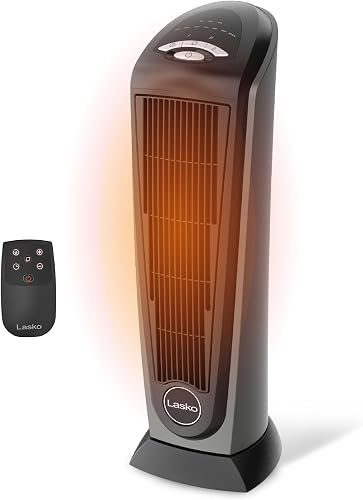
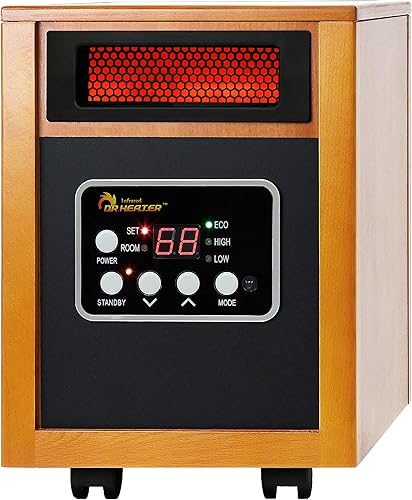
The Lasko 751320 is the clearest choice for easy carrying and shared airflow. Consider the Dr Infrared DR-968 for a cabinet you can roll between rooms on one floor, or WEWARM for a smaller cabinet with more heat-setting options.
Ceramic vs infrared heater: how does each warm a room?
A ceramic fan heater warms moving air, while infrared heating transfers radiant energy to surfaces in its path. Many infrared cabinets combine heating methods, so buying one doesn't necessarily mean getting silent, fan-free warmth.
In a ceramic heater, air passes over a heated ceramic element and returns to the room. Oscillation changes the direction of that airflow, which helps when people sit in different parts of a small seating area.
Radiant heat can warm people and objects within its reach without first warming all the surrounding air. Furniture can block that path, making placement especially important for heaters that rely mainly on radiant output.
The 2 infrared choices here aren't simple radiant panels. The Dr Infrared combines quartz and PTC heating with a blower, while WEWARM pairs quartz elements with forced air.
Is a ceramic or infrared heater better for quick warmth?
Direct airflow can provide early comfort at your seat, but neither type name proves faster whole-room heating. A cold, drafty room takes longer to warm than a smaller, enclosed room.
Aim for a safe placement that serves the occupied area without blowing uncomfortably at your face or legs. Turning the thermostat far above your target won't increase the heater's maximum output.
Which model should you buy for your daily routine?
Choose the Lasko for frequent room changes, the Dr Infrared for a cabinet that stays on one floor, or WEWARM for adjustable output in a smaller cabinet. Each solves a different practical problem.
Lasko 751320: for shared airflow and easy carrying
The Lasko suits a home office where warmth needs to reach more than one desk or chair. Its oscillation is useful when you want airflow to sweep across an occupied area rather than remain pointed at one person.
It weighs 2.5 lb and has a carry handle, making it the easiest of these choices to carry upstairs after cooling. Skip it if moving air bothers you or your main goal is a fan-free room.
Dr Infrared DR-968: for a cabinet that stays downstairs
The Dr Infrared suits a living room where you have a clear floor position and can roll the heater to another nearby room. Its quartz and PTC combination uses a blower to distribute warmth.
At 19 lb, it makes less sense for daily trips between floors. Choose it for a suitable permanent spot and occasional rolling moves, rather than expecting its infrared label to deliver more heat from the same electrical input.
WEWARM: for changing heat needs in one room
WEWARM suits buyers who want to switch between 1000W, 1500W and ECO mode as room conditions change. A defined lower-power setting is useful when you need less heat than full output provides.
Its cabinet weighs 6.4 lb, making it easier to carry than the Dr Infrared but heavier than the Lasko. Skip it if oscillation is essential or you want infrared warmth without fan airflow.
How should room size change your choice?
Use room size, drafts and layout together, rather than buying from a coverage number alone. A heater serving an enclosed office has a different job from one facing an open stairwell.
Lasko describes its tower as suitable for medium-sized rooms. Dr Infrared gives a coverage figure of 576 sq ft, while WEWARM claims up to 300 sq ft.
Those figures don't form a dependable performance ranking because room conditions and coverage assumptions can differ. They also don't mean the Dr Infrared supplies several times as much heat as the Lasko.
All 3 reach a maximum of 1500 watts. A large open room may lose heat faster than any of them can replace it, especially with poor insulation or frequent door opening.
Measure the room and note ceiling height before choosing. Our guide to what size space heater you need explains how room conditions affect the decision.
For broader options, compare the best space heaters for home. If you need supplemental warmth across a bigger area, use our large-room space heater guide to narrow the choices.
Which heater gives you useful control over comfort?
Choose controls that match your schedule and preferred temperature, rather than the longest feature list. A remote helps with adjustments, while a thermostat helps limit unnecessary heating once the room warms.
The Lasko offers 2 heat settings, a thermostat range of 60°F to 85°F and a 7-hour timer. Its remote also controls oscillation, which is useful when you want to stop airflow sweeping past your chair.
The Dr Infrared has a 50°F to 85°F thermostat and a 12-hour automatic shutoff timer. WEWARM extends the thermostat range to 90°F and also offers a timer up to 12 hours.
A wider range matters only if you need those settings. A high maximum temperature isn't evidence of greater heat output, and a long timer isn't permission to leave the heater running unattended.
Start near your normal comfort temperature, then adjust in small steps. The heater senses conditions near its own position, so a cold corner or chair across the room may feel different.
Does a ceramic or infrared heater cost less to run?
Power draw and runtime determine electricity use, so neither heating label guarantees lower bills. At equal draw and runtime, these electric resistance heaters use the same amount of electricity.
An hour at a continuous 1500 watts uses 1.5 kilowatt-hours. An hour at 1000 watts uses 1 kilowatt-hour, though the lower setting also supplies less heat during that hour.
Multiply kilowatt-hours by your electricity rate to estimate the energy cost. Our guide to space heater running costs walks through that calculation.
Thermostat cycling changes actual consumption because the heating element may switch off once the target is reached. ECO mode can adjust operation, but its name doesn't tell you how much electricity your room will need.
A useful saving comes from heating an occupied room for the time you need it. Lower output may simply run longer in a cold room, so compare total use rather than assuming the lower setting always wins.
For the electrical basics behind those choices, read how many watts a space heater uses.
Which heater is easier to fit beside furniture?
The Lasko needs the least floor space, but every heater needs an open safety area beyond its physical footprint. Measure the clear operating space, not just the gap between furniture.
The Lasko measures 8.3 in deep, 7.25 in wide and 22.5 in tall. Its narrow tower shape can fit a room layout where a wider cabinet would intrude into a walking route.
The Dr Infrared measures 13 in deep, 11 in wide and 16 in tall. WEWARM measures 9.84 in deep, 10.03 in wide and 12.6 in tall.
Don't tuck a cabinet under a desk or against a sofa just because it fits. Restricted airflow, hanging blankets and nearby papers can turn a convenient spot into an unsuitable one.
Choose a stable, level floor position with the outlet within reach. Wheels help move a cooled heater across a suitable surface, but the unit still needs a secure position during use.
Which type suits quiet work or bedroom use?
Choose by fan behavior and your tolerance for airflow, rather than assuming infrared means silent. All 3 choices here move air, so none is the obvious answer for someone who wants no fan at all.
Dr Infrared gives a sound figure of 39 dB, while WEWARM gives 34 dB. Without matching measuring conditions, those numbers don't prove which will sound quieter beside your desk.
Think about where the heater will sit relative to your ears and microphone. A unit close to your chair can be more distracting than one farther away, even if both make the same sound.
For bedroom use, warm the room while you're awake and turn the heater off before sleeping. A timer or remote makes operation easier but doesn't change that rule.
If fan sound is your main concern, compare the designs in our quiet space heater guide.
How should you set up either heater safely?
Set up either type on a clear, stable floor near a suitable wall outlet, following its manual. Plug it directly into the outlet instead of using a power strip or extension cord.
Check that the cord can reach without crossing a walkway or stretching tight. Don't run it under a rug, behind furniture that can crush it, or where a chair wheel can roll over it.
Keep bedding, curtains, clothing and furniture outside the manual's required clearances. Allow space around the back and sides as well as in front of the outlet.
The Lasko has overheat protection, and Lasko describes its housing as cool-touch. Both infrared models have tip-over and overheat protection; WEWARM also describes its exterior as cool-touch.
These features don't make a heater safe to cover or safe for children and pets to approach. Hot air outlets and nearby surfaces still need care.
Turn the heater off before sleeping or leaving home. Read our space heater safety guide and the explanation of whether you can plug a space heater into an extension cord before choosing its location.
What care keeps airflow clear?
Remove dust as the manual directs, with the heater unplugged and fully cool. Dust around air inlets and outlets can restrict airflow, so care matters for both ceramic towers and fan-assisted infrared cabinets.
Check the vents regularly if the room collects pet hair or lint. Clean only accessible areas using the method the manual permits, and don't push tools through the grille.
The Dr Infrared includes a filter described as lifetime. That doesn't mean it needs no care; follow its cleaning instructions rather than assuming it can be ignored or washed.
Don't open the housing to reach an element or spray liquid into the heater. If a cord is damaged, the plug fits loosely, or the unit repeatedly shuts down unexpectedly, stop using it and address the cause.
Let the heater cool before moving or storing it. Store it somewhere dry, with the cord protected from sharp bends and heavy objects.
Which common buying mistakes should you avoid?
Avoid choosing by heat-type labels alone or expecting a heater to overcome an unsuitable room. The strongest choice is one you can place safely and use comfortably during your normal routine.
- Assuming infrared means no fan. Both infrared cabinets here use air movement, so they don't solve a strict fan-free requirement.
- Treating coverage as a guarantee. A drafty room with an open doorway can be harder to warm than a larger enclosed space.
- Buying before measuring. A heater that physically fits may still lack the operating clearance its manual requires.
- Turning the thermostat to maximum for speed. The target temperature doesn't increase the heater's maximum power.
- Confusing lower wattage with equal heat for less energy. Lower output can be useful, but it may need more runtime.
- Using a timer as supervision. Automatic shutoff doesn't replace turning the heater off before leaving or sleeping.
Also avoid buying a heavy cabinet for a routine that involves stairs. Portability means being able to make your actual room changes safely, not simply having wheels or a carry handle.
Which should you buy, a ceramic or infrared heater?
Choose the Lasko for shared airflow and frequent carrying, the Dr Infrared for a cabinet that stays mostly on one floor, or WEWARM when a defined lower-power setting fits your routine. Skip all 3 if your main requirement is heat without a fan.
For your ceramic vs infrared heater decision, first rule out models that don't fit the safe floor space near your outlet. Then choose the airflow and controls you'll use, without expecting the infrared name to lower electricity costs.
If oscillation is the deciding feature, compare more options in our best ceramic tower heaters guide. If you prefer a different approach to room warmth, our oil-filled heater vs ceramic heater guide is the next useful comparison.
Frequently asked questions
Is a ceramic or infrared heater better?
Ceramic suits buyers who want oscillating warm air, while an infrared cabinet can suit a room where its footprint and controls work better. The infrared examples here also move air.
Choose by placement, heat settings and how you use the room, rather than expecting the type name to settle everything.
Does an infrared heater heat a whole room?
An infrared heater with a blower can help warm room air as well as provide radiant heat. The Dr Infrared DR-968 combines quartz and PTC heating with a blower.
An open doorway, drafts or a high ceiling can still make the space difficult to heat, regardless of a coverage claim.
Do ceramic heaters use more electricity than infrared heaters?
Neither type automatically uses more electricity. At the same power draw and runtime, their electricity use is the same.
Lower settings and thermostat cycling can reduce consumption, but savings depend on how long the heater actually draws power.
Compare your heating routine as carefully as the heater's maximum wattage.
Which type is quieter?
Neither type guarantees quieter operation because both can include fans. Dr Infrared gives a sound figure of 39 dB, and WEWARM gives 34 dB.
Different measuring distances and operating settings can change those figures, so they don't establish a reliable ranking without matching conditions.
Consider airflow noise as well as thermostat cycling.
Are ceramic and infrared heaters safe to use?
Both types need clear space, a suitable wall outlet and use according to the manual. Automatic shutoffs reduce certain risks but don't replace supervision.
Keep combustible items away, turn the heater off before sleeping or leaving, and keep children and pets clear.
Read our space heater safety guide for practical precautions.