DREO Space Heaters with Thermostat Review: Worth It? (October 2026)
This DREO space heaters review favors the DREO 1500W Thermostat Heater for its shorter body, ECO mode and timer. Choose the taller DREO for a child lock and finer temperature settings, or Lasko for straightforward controls.
On this page (9 sections)
- What stands out in this DREO space heaters review?
- How do the two DREO heaters compare?
- Is the Lasko a good alternative to DREO?
- What room and heating needs suit these towers?
- How should you set up a DREO tower heater?
- What safety features matter during daily use?
- How do you care for a ceramic tower heater?
- Which mistakes should you avoid before ordering?
- Which heater should you choose?
The DREO 1500W Thermostat Heater is the strongest all-around choice in this DREO space heaters review for an occupied office or sitting room. Choose the taller DREO for its child lock and finer temperature adjustments, or the Lasko for a simpler daily routine.
All 3 are ceramic fan heaters with thermostats. Your decision should turn on placement, controls and how you use the room, since a taller cabinet doesn't automatically provide more heat.
What stands out in this DREO space heaters review?
The shorter DREO offers the most useful mix for everyday spot heating, while the taller model adds controls that suit a shared room. NeatUpgrade compared their features, dimensions and stated coverage with the Lasko alternative.
These heaters make sense when you want warmth in the room you're using. A ceramic fan heater sends warm air into that space quickly, but the room will lose heat after you switch it off.
For a desk or reading chair, direct airflow can matter more than broad room coverage. For several people sitting apart, oscillation can spread the airflow instead of keeping it aimed at one seat.
DREO space heater review: who should choose the shorter tower?
Choose the shorter DREO for an occupied home office or sitting area where a compact body and automatic heat adjustment matter. Skip it if a child lock or separate fan mode is central to your decision.
DREO 1500W Thermostat Heater

- 1500W PTC ceramic heat
- 70° oscillation
- ECO mode
- 12-hour timer
The shorter DREO suits an occupied office or sitting room where you want automatic heat adjustment without a tall tower. Its timer helps you plan a shutoff around your work or evening routine.
Pros
- ECO mode adjusts between 1000W and 1500W
- Remote control and wide-angle oscillation
- 12-hour timer and automatic shutoff after 24 hours without interaction
- Built-in tip-over and overheat protection
Cons
- No child lock among its stated features
- Short body still requires open floor space and clearance
The DREO 1500W Thermostat Heater stands 15.79 in tall, with a body about 5.9 in deep and wide. That makes it easier to fit into a clear floor location than the taller DREO, though its safety clearances still take priority.
Its ECO mode adjusts between 1000W and 1500W according to room temperature. This suits a workday when you want the heater to respond as the room warms, rather than keep selecting a heat level yourself.
The 12-hour timer is useful for a planned shutoff, such as the end of an evening in the living room. The separate automatic shutoff after 24 hours without interaction is a backup feature, not a reason to leave it unattended.
DREO states a noise level of 34 dB. Consider this model for reading or office work if a low fan hum is acceptable; choose a different heater type if any moving-air sound bothers you.
Who should choose the taller DREO?
Choose the taller DREO for a shared room where control options matter more than the smallest footprint. Skip it if you only need basic warmth beside one chair and won't use its extra modes.
DREO 25 Inch Space Heater

- 1500W PTC ceramic heat
- 1°F temperature adjustments
- Child lock
- Four heating modes plus fan mode
Choose this taller DREO for a shared room where a child lock and finer thermostat adjustments are useful. Its separate fan mode adds air circulation without heat.
Pros
- H1, H2, H3 and ECO heating modes
- Child lock plus tip-over and overheat protection
- Temperature setting from 41–95°F in 1°F steps
- Remote control and 70° oscillation
Cons
- Larger floor footprint than the shorter DREO
- Same maximum heat output as the shorter model
The DREO 25 Inch Space Heater has H1, H2, H3 and ECO heating modes, plus a separate fan mode. The heat levels let you choose a steady setting, while ECO handles temperature-based adjustment.
Its thermostat adjusts in 1°F steps. That's useful if you tend to find one setting too warm and the next too cool, although a precise setting doesn't mean every corner reaches the same temperature.
The child lock helps prevent unwanted control changes. It doesn't make the heater safe for children to touch, cover or play around, so placement remains the first concern in a family room.
DREO states noise as low as 25 dB, making this the more appealing DREO for readers who prioritize a low stated sound level. Both models use fans, so neither should be chosen on the assumption of silent heat.
How do the two DREO heaters compare?
The taller DREO adds control choices, not greater maximum heat output. Both reach 1500W and offer 70° oscillation, so choose their shape and controls around your room rather than expecting the taller one to solve greater heat loss.
| Feature | DREO 1500W Thermostat Heater | DREO 25 Inch Space Heater |
|---|---|---|
| Height | 15.79 in | 25 in |
| DREO's heating coverage | 270 sq ft | 100–270 sq ft |
| Heat settings | Low and high; ECO mode | H1, H2, H3, ECO; separate fan mode |
| Temperature range | 41–95°F | 41–95°F, adjustable in 1°F steps |
| Depth and width | 5.9 x 5.89 in | 7.87 x 7.87 in |
| Controls | Remote control | Remote control and child lock |
| Protection | Tip-over and overheat protection | Tip-over and overheat protection |
Measure the whole usable location, including the space around the heater. A narrow gap between furniture may fit the cabinet while leaving too little room for safe airflow.
For more options with automatic temperature control, see our guide to space heaters with thermostats. Focus on the controls you'll actually use rather than the longest feature list.
Is the Lasko a good alternative to DREO?
The Lasko is a sensible alternative for straightforward daily use if you want a thermostat, remote and timed shutoff. Choose a DREO instead if ECO mode or the taller model's child lock is a priority.
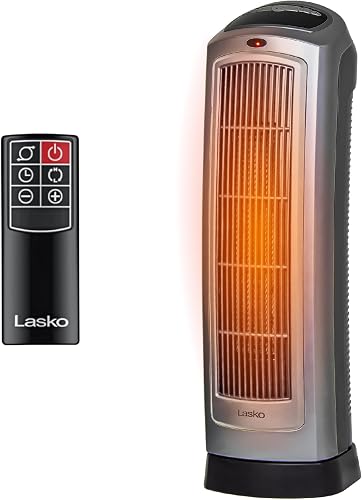
Lasko Digital Tower Heater
- 1500W ceramic heat
- Adjustable thermostat
- 1–8 hour timer
- Remote control
The Lasko suits readers who want two heat settings, a thermostat and a timed shutoff without extra modes. A carry handle and rear remote storage help when moving it between rooms.
Pros
- Timer adjusts in 1-hour steps
- Remote controls the thermostat and oscillation
- Overheat protection and cool-touch exterior
- Comes fully assembled
Cons
- No child lock or tip-over protection among its stated features
- No ECO mode among its stated features
The Lasko Digital Tower Heater stands 23 in tall and arrives fully assembled. Its two heat settings and optional oscillation suit someone who wants to turn on the heat, set a comfortable temperature and settle into a chair.
Its timer runs from 1–8 hours in 1-hour steps. The remote handles power, temperature, timer and oscillation, then stores on the back of the heater.
A built-in carry handle helps when moving it between rooms after it has cooled. Plan a safe outlet location in each room before buying, rather than assuming you can place it anywhere you need warmth.
Lasko describes the exterior as cool to the touch and includes overheat protection. For a household where tip-over protection is a deciding factor, choose one of the DREO models here, which explicitly includes it.
What room and heating needs suit these towers?
These towers suit supplemental heat in an enclosed room, especially where people want warm airflow while sitting or working. An open-plan space, drafty room or high ceiling makes the task harder for a portable heater.
Start by multiplying room length by width to find the floor area. Then consider what the number leaves out: an open staircase, poorly sealed windows and frequent door opening all let warmth escape.
DREO's coverage figures put both models in a similar room-size bracket. The shorter model's single coverage number doesn't establish an advantage over the taller model's range.
For a larger space, compare the layout advice in our guide to space heaters for large rooms. Avoid choosing any tower solely because its name mentions a large room.
Should you use oscillation or fixed airflow?
Use fixed airflow for one occupied spot and oscillation when warmth needs to reach several seating positions. Oscillation changes where the air goes; it doesn't increase the heater's electrical heat output.
Aim the heater toward a clear part of the occupied area. Furniture can block airflow, so moving a heater to a safer, more open location can help more than raising its thermostat.
For bedroom use, decide where it can run safely while you're awake without blowing directly at bedding. Our guide to the best space heaters for bedrooms covers the placement and comfort trade-offs.
Does ECO mode mean lower electricity use?
ECO mode can reduce electricity use when less heat is needed, but it doesn't guarantee a lower bill. Room heat loss, your target temperature and running time determine how much electricity the heater uses.
A heater drawing 1500W continuously uses 1.5 kWh in 1 hour. Multiply that by your electricity rate to estimate the cost for that hour, then account for periods when the heater reduces output or cycles off.
Don't set the thermostat higher to try to warm the room faster. A higher target usually asks the heater to keep heating longer rather than create extra output beyond its limit.
See how many watts a space heater uses for power basics. Our guide to space heater running costs explains how to calculate a useful household estimate.
How should you set up a DREO tower heater?
Start with a stable, level floor location near a suitable wall outlet, with the clearances required by the manual. Keep the heater out of walkways and away from curtains, bedding, papers and upholstered furniture.
Don't put a tower on a desk or shelf to raise the airflow. These are floor-mounted heaters, and a short cabinet still needs an open, safe position.
Before the first use, remove all packaging and inspect the cord and plug for damage. Read the controls section of the manual so you know how to stop the heater and cancel a timer.
Plug directly into the wall rather than an extension cord or power strip. Route the cord where it won't be pinched, walked on or covered by a rug.
Start at a comfortable temperature and adjust after the room has had time to warm. A thermometer near your usual seat can help you judge comfort away from the heater's built-in sensor.
Keep air inlets and outlets clear. If the heater shuts down unexpectedly, switch it off, unplug it and follow the manual's instructions before using it again.
What safety features matter during daily use?
Protection features support careful use; they don't replace supervision. Both DREO models include tip-over and overheat protection, and DREO identifies them as ETL certified.
The taller DREO's child lock limits control changes, while the shorter model adds an inactivity shutoff. Neither feature keeps a blanket from blocking airflow or a pet from pushing something against the heater.
A timer is useful when you're reading or working and want a reminder built into the routine. Turn the heater off yourself before leaving the room or going to sleep, even if time remains on the timer.
Read our space heater safety guide for placement and operating advice. For the specific bedtime decision, see whether you can leave a space heater on overnight.
How do you care for a ceramic tower heater?
Keep the vents clear and clean the heater only when it's unplugged and cool. Dust buildup can restrict airflow, so check the intake and outlet regularly during periods of frequent use.
Follow the manual's cleaning method, using only the tools and access points it allows. Don't spray cleaner into the vents, immerse the heater or open the housing for routine care.
Check the cord and plug when you move the heater. Stop using it if you find damage, scorching, a loose outlet connection or unusual plug or outlet heat, and have the problem checked.
Store the cooled heater in a dry place with the cord loosely arranged. Avoid tight bends around the cabinet or placing heavy objects on the cord.
Which mistakes should you avoid before ordering?
The most common buying mistake is choosing by tower height or coverage alone. Start with a safe floor location, then choose the controls that fit how you'll use the room.
- Buying before checking outlet access: the right location must be within reach of the heater's own cord.
- Confusing the thermostat with the timer: the thermostat manages temperature; the timer ends a session after a set period.
- Expecting fan mode to cool the room: it moves air without adding heat, but it isn't air conditioning.
- Using a portable heater to cover major heat loss: drafts and open doorways can keep it running without making the whole space comfortable.
- Treating a child lock as a safety barrier: children and pets still need separation from the heater.
If you haven't settled on a heater type, our guide to how to choose a space heater helps you compare airflow, room use and size before narrowing the model.
Which heater should you choose?
Choose the shorter DREO for compact placement and automatic heat adjustment. It leads this DREO space heaters review for readers who want useful everyday controls without a tall tower.
Pick the taller DREO when a child lock, finer temperature settings and separate fan mode will earn their place in your routine. Choose the Lasko when simple heat settings, remote storage and a timed shutoff cover your needs.
If you need silence or warmth that lingers after shutdown, compare other heater types before ordering a ceramic tower. Our best space heaters for home guide is the next step for choosing between ceramic, oil-filled and infrared heat.
Frequently asked questions
Which DREO space heater has a thermostat?
Both DREO models here have thermostats with settings from 41–95°F. The taller model allows adjustments in 1°F steps, while the shorter model combines temperature control with ECO mode and two heat levels.
Choose by the controls you'll use and the floor space available, rather than tower height alone.
How large a room can these DREO heaters cover?
DREO gives the shorter heater coverage of 270 sq ft and the taller model a range of 100–270 sq ft. Use those figures as a starting point for an enclosed room.
Drafts, high ceilings, open doorways and poor insulation can increase heat loss and reduce comfort.
Can I use a DREO space heater with an extension cord?
Plug a space heater directly into a suitable wall outlet rather than an extension cord or power strip. DREO explicitly requires this for the shorter model.
Choose a location the heater's own cord can reach, follow its manual, and read our guide to space heater extension cord safety.
Is the DREO 25 Inch Space Heater quiet?
DREO states a noise level as low as 25 dB for the taller heater. It suits buyers who prioritize low fan noise while reading or working, but it still moves air.
Sound can vary with operating mode, distance and room acoustics, so don't expect silent operation.